
Documentation Index

Fetch the complete documentation index at: https://docs.iru.com/llms.txt

Use this file to discover all available pages before exploring further.

Sources connect Iru Compliance to systems you already use, such as identity, code hosts, monitoring, HR, cloud, and more. After a source is Active, Iru can discover and attach artifacts to the actions and controls they support, which keeps evidence tied to your frameworks and reduces manual uploads. To see how Compliance fits with Endpoint and Identity, read Iru Overview. On the left navigation bar, expand Compliance and select Sources. Turn on the toggle on a source’s card, then complete authentication in the wizard (OAuth, API keys, bearer tokens, or vendor-specific steps). When an action names a system and evidence type, automation can use that mapping to decide what to collect.
Need help with a step? Contact Iru Support.

Sources page

Once you are on Sources (same sidebar path as above), Refresh all evidence is at the top right. Use it to refresh evidence from your connected sources. Use Search by name or description and the Category dropdown to narrow the list. Amazon Web Services connectors appear under Amazon sources inside each relevant category (Security, Developer tools, Databases, Monitoring, or Storage). Each Amazon sources row scrolls horizontally. Use the arrow controls to see every card.

How it works

Each connector article covers authentication, in-product steps (including the Iru connector wizard where applicable), troubleshooting, and vendor documentation links. Read the article for your system before you turn the source on in Sources.

Connector articles

The sidebar Compliance → Sources tree follows the same Category labels as Iru (Analytics, Communications, CRM, Databases, Developer tools, HRIS, Monitoring, Productivity, Project management, Security, Storage, Support), with Amazon sources nested where the product groups AWS connectors. Browse sources by theme below (accordion sections mirror connector families such as Amazon Web Services for documentation). Expand a section to see Integration links to full guides and What it covers summaries. In Iru, expand Compliance, open Sources, and use each card’s toggle; your tenant controls which connectors are listed.
IntegrationWhat it covers
FivetranConnectors and pipeline metadata for data-movement governance.
SegmentSources, destinations, and workspace settings for customer-data pipelines.
IntegrationWhat it covers
AircallVoice and messaging platform metadata for communications controls.
RingCentralVoice, messaging, and account configuration for communications controls.
SlackWorkspace membership, channels, and app integrations for collaboration controls.
IntegrationWhat it covers
AttioCRM records and workspace structure for customer-data controls.
WordPressUsers, roles, and REST-accessible site metadata for CMS controls.

Amazon sources

IntegrationWhat it covers
Amazon Redshift Data APIData API usage and SQL-layer inventory for Redshift governance.
Amazon Redshift ServerlessServerless workgroups, namespaces, and related configuration.
AWS DynamoDBTables, indexes, and backup settings (configuration and inventory, not item data).
AWS RDSDB instances, Aurora clusters, snapshots, and encryption settings (no query data).
AWS RedshiftProvisioned clusters, subnet groups, snapshots, and encryption posture.

Other integrations

IntegrationWhat it covers
SnowflakeACCOUNT_USAGE metadata, roles, and warehouses via read APIs (not arbitrary SQL).

Amazon sources

IntegrationWhat it covers
AWS CodeCommitGit repositories, branches, and pull-request settings for change management.
AWS Elastic Kubernetes Service (EKS)Clusters, node groups, and Kubernetes inventory for container security.
AWS Elastic Compute Cloud (EC2)Instances, security groups, VPC layout, and AMI metadata.
AWS Elastic Container Service (ECS)Services, tasks, and cluster configuration for container compliance.
AWS Elastic Load Balancing (ELB)Listeners, rules, target groups, and health checks for ingress controls.
AWS LambdaFunctions, triggers, and IAM attachments for serverless governance.
AWS OrganizationsAccounts, OUs, roots, and SCP evidence for landing-zone controls.
AWS Auto ScalingScaling groups, policies, and capacity evidence across compute.

Microsoft Azure

IntegrationWhat it covers
Microsoft Azure AuthorizationRole assignments and RBAC policy administration for resources and resource groups.
Microsoft Azure Key VaultKey Vault inventory and access policies via the management API (not secret values).
Microsoft Azure MonitorDiagnostic settings and export of resource logs and metrics to supported destinations.
Microsoft Azure NetworkVirtual networks, subnets, interfaces, public IPs, NSGs, load balancers, VPN gateways, and related networking resources.
Microsoft Azure StorageStorage accounts and configuration within an Azure subscription.

Other integrations

IntegrationWhat it covers
BitbucketRepositories, branch policies, and workspace access for code governance.
ContentfulContent models, entries, and roles for CMS access controls.
DigitalOceanDroplets, Kubernetes, databases, and networking inventory where enabled.
DopplerProjects and sync metadata for secrets governance (not secret values).
DrupalJSON:API users, roles, and content metadata for web CMS controls.
FigmaProjects, files, org membership, and OAuth-scoped design-system evidence.
GitHubOrgs, repos, branch protection, teams, and audit-oriented settings.
GitLabGroups, projects, CI/CD configuration, and membership for DevOps controls.
HerokuApps, pipelines, collaborators, and add-ons for PaaS evidence.
JenkinsJobs, plugins, and CI configuration for build and deployment controls.
OpenAIOrg and project metadata for AI usage and access governance.
PagerDutyServices, incidents, schedules, and escalation evidence for incident response.
PostmanWorkspaces, collections, and API governance surfaces exposed by API.
IntegrationWhat it covers
BambooHREmployee records and HR workflows for workforce compliance evidence.
CheckrBackground screening status and employment verification records.
LatticeReviews, goals, and HR program metadata tied to people compliance.
Sage HRHR employee and absence metadata available via API for workforce evidence.
WorkableJobs, candidates, and recruiting pipeline metadata for HR compliance.
Workday ReportCustom HR reports via Workday RaaS for payroll and workforce evidence.

Amazon sources

IntegrationWhat it covers
AWS CloudWatchMetrics, alarms, and monitoring configuration for operational controls.

Other integrations

IntegrationWhat it covers
DatadogMonitors, users, integrations, and security-related configuration via API.
SentryProjects, releases, and error-tracking configuration for application security.
IntegrationWhat it covers
ConfluenceSpaces, pages, and Atlassian access for documentation governance.
DocusignEnvelopes, recipients, and audit metadata for e-signature controls.
EnvoyWorkplace visitors and location settings where applicable to physical security.
NotionPages, databases, users, and workspace structure for knowledge governance.
Reach 360Training enrollments, completions, content, and groups from Articulate Reach 360.
IntegrationWhat it covers
Aha!Roadmaps, ideas, and workspace metadata for product governance evidence.
AsanaWorkspaces, projects, and tasks for access and collaboration reviews.
ClickUpWorkspaces, lists, tasks, and members for operational evidence.
JiraProjects, issues, workflows, and service-management evidence.
ShortcutStories, epics, and workflow metadata for engineering governance.
TrelloBoards, lists, cards, and members for lightweight project evidence.
IntegrationWhat it covers
Iru EndpointDevice enrollment, posture, and endpoint inventory from Iru Endpoint.
1PasswordAudit and access events from your password manager (Events Reporting API).

Amazon sources

IntegrationWhat it covers
Amazon InspectorEC2 and container vulnerability and assessment findings.
AWS CloudTrailManagement events and trail configuration for API audit evidence.
AWS ConfigResource inventory, rules, and configuration timeline per Region.
AWS GuardDutyThreat-detection findings and detector configuration.
AWS IAMUsers, roles, policies, MFA, and credential reports for access reviews.
AWS IAM Identity Center (Identity Store)Directory users, groups, and memberships (identitystore: APIs).
AWS IAM Identity Center (SSO)Permission sets, assignments, and SSO applications (sso: APIs).
AWS Key Management Service (KMS)CMK metadata, rotation settings, and key policy evidence (not cleartext keys).
AWS Secrets ManagerSecret rotation metadata and inventory (not secret values).
AWS Security HubAggregated controls and findings across integrated AWS security services.

Other integrations

IntegrationWhat it covers
CloudflareDNS, WAF, and edge security configuration for perimeter controls.
HashiCorp VaultPolicies, mounts, and metadata for secrets-engine governance (not secret payloads).
JumpCloudDirectory, SSO, MDM, and device inventory for unified identity evidence.
KnowBe4Training campaigns and phishing simulation completion records.
OktaUsers, groups, MFA, apps, and SSO policies for identity evidence.
SemgrepStatic analysis findings, projects, and policies from Semgrep Cloud.

Amazon sources

IntegrationWhat it covers
AWS Elastic File System (Amazon EFS)File systems, mounts, and encryption posture for shared storage.
AWS S3Bucket policies, encryption, logging, and public-access blocks (not object bodies).

Other integrations

IntegrationWhat it covers
BoxEnterprise content, folders, and collaboration permissions.
IntegrationWhat it covers
IntercomWorkspace apps, conversations metadata, and admin surfaces exposed by API.

Enable a source

1

Open Sources

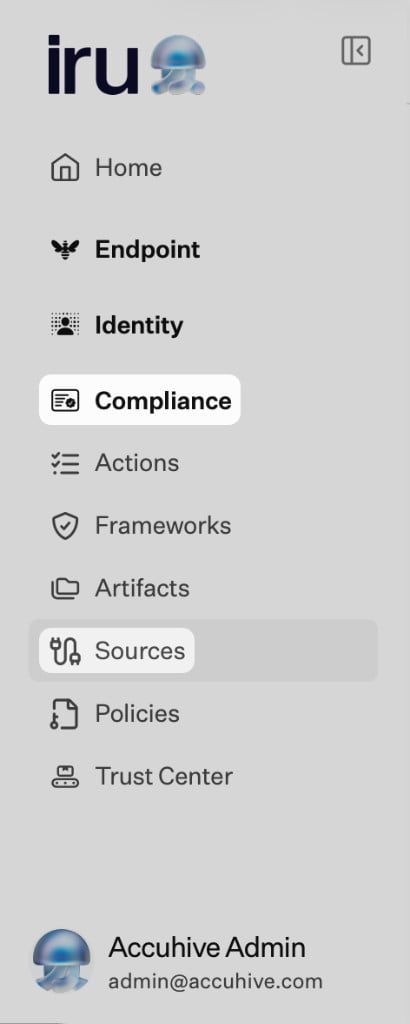
On the left navigation bar, expand Compliance and select Sources.
Left navigation: Compliance expanded, Sources selected
2

Turn on the integration

Find the source card (use Search by name or description or Category if you need to narrow the list). On that card, turn on the toggle. A browser tab or window may open for the connector wizard (OAuth, API key, IAM role, or other prompts depending on the integration).
3

Finish the wizard

Complete the wizard until the card shows Active. See the connector article for your system if you need field-level detail.
If nothing opens when you turn the toggle on, check pop-up blocker settings for the Iru site and try again.

Disable or remove a source

When a source is already Active, click its toggle again. Iru prompts you to confirm that you want to remove that source. Select Yes, remove to disable the integration and turn the source off. Select Cancel to dismiss the prompt and leave the source Active. If expected artifacts do not appear after the source is Active, confirm your actions describe which evidence should come from that system and that the connected account has the scopes or permissions the connector needs.