

About AWS CloudTrail
CloudTrail evidence typically includes management events viaLookupEvents plus configuration metadata for trails. LookupEvents covers roughly the last 90 days - older analytics require S3 archive permissions (s3:GetObject) and possibly kms:Decrypt when trails use customer-managed CMKs.
How It Works
Iru runs in its own AWS account. To read CloudTrail trail and logging metadata in your account, you create an IAM role withsts:AssumeRole trust (wizard External ID) and read-only cloudtrail: (and s3: / kms: only if your trails require those reads). Paste the role’s ARN back into Iru.
Attach AWSCloudTrail_ReadOnlyAccess. Add the optional inline kms:Decrypt statement only when you deliberately ingest encrypted trail archives from S3.
Prerequisites
- IAM rights to create roles.
- Awareness whether audits demand API lookups only vs S3 archive depth.
Connect AWS CloudTrail to Iru
- Iru Compliance
- AWS
Start here: open the source wizard and copy the trust policy (and note the external ID). When you are ready to create the role in AWS, switch to the AWS tab and follow Create the IAM role in AWS. After you have the Role ARN, return to the Iru Compliance tab and complete Submit the role ARN in Iru below.
Get the trust policy from Iru
1
Open Sources
In Iru Compliance, on the left navigation bar, expand Compliance and select Sources.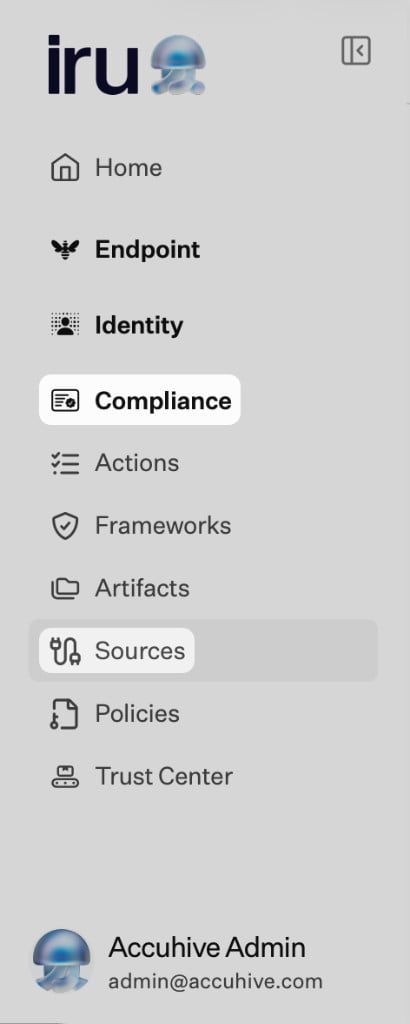
2
Turn on AWS CloudTrail
Find AWS CloudTrail (use Category or Search by name or description). On that card, turn on the toggle. Leave the Iru is requesting access to external services wizard tab open.
3
Copy the trust policy JSON
The wizard shows the trust policy JSON your IAM role must use (Principal and sts:ExternalId). Below is an example of the structure; copy the live JSON from your wizard so the account, principal ARN, and external ID match exactly.
copy=false
4
Switch to AWS to create the role
Keep the Iru wizard tab open for reference, then switch to the AWS tab and follow Create the IAM role in AWS.
Submit the role ARN in Iru
Finish the AWS tab first (through Create the IAM role in AWS) so you have the Role ARN from the new role.
1
Paste the IAM Role ARN
Return to the Iru wizard tab. Paste the Role ARN where the connector prompts for it.
2
Finish the connection
Select Submit Role. When the connection succeeds, the wizard shows Connection Configured.
3
Confirm the source is Active
Close the Iru is requesting access to external services browser tab, then return to Compliance → Sources and confirm the AWS CloudTrail card is Active.
Troubleshooting
Nothing opens when you turn the source on
Nothing opens when you turn the source on
Check pop-up blocker settings for the Iru site and try again.
Events older than ~90 days missing
Events older than ~90 days missing
Use S3 archive ingestion paths - requires
s3:GetObject + optional kms:Decrypt.AssumeRole denied
AssumeRole denied
External ID mismatch.
Considerations
Multi-Region / Organization trails affect where…
Multi-Region / Organization trails affect where APIs must run - mirror AWS best practices for centralized logging.
Related Articles
Sources Management
Browse and manage every Compliance source.
Getting Started With Compliance
Frameworks, actions, and Artifacts.
Iru Overview
How Endpoint, Compliance, and Identity fit together.
Artifacts Management
Upload, review, and organize evidence from sources and actions.