

About Snowflake
Iru collects warehouse and account usage, database/schema metadata, roles and grants, and login/query history from Snowflake, primarily viaSNOWFLAKE.ACCOUNT_USAGE views. Authentication uses key-pair authentication: short-lived JWTs signed with your RSA private key, verified against the public key registered on the Snowflake user Iru uses.
How It Works
Official references: Key-pair authentication, Account identifiers, REST API, ACCOUNT_USAGE.
Prerequisites
SECURITYADMIN(or equivalent) to assignRSA_PUBLIC_KEYon a dedicated service user.- OpenSSL (or another tool) to generate a 2048-bit (or larger) RSA key pair.
- Your account identifier (
orgname-accountnamepreferred, or legacy locator with region/cloud if required).
Connect Snowflake to Iru
- Snowflake
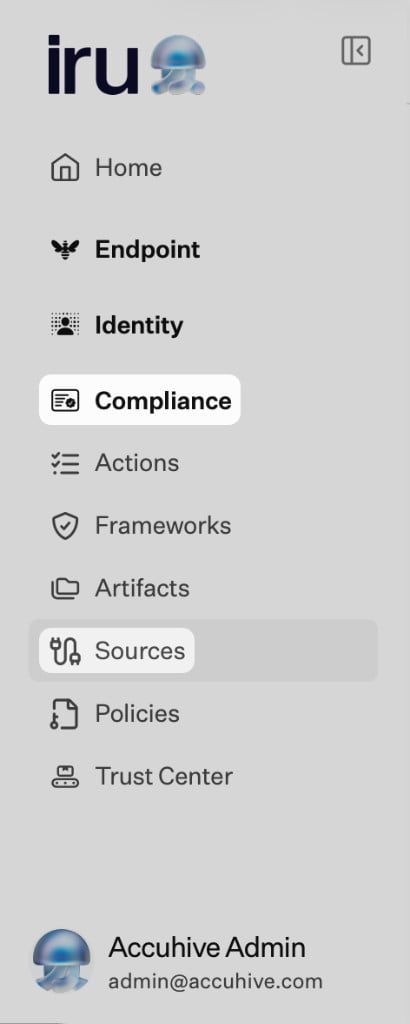
- Iru Compliance
Complete this tab before you connect the source in Compliance.
1
Confirm Snowflake admin access
Sign in to Snowsight or the classic console with
SECURITYADMIN (or equivalent) so you can run ALTER USER and GRANT statements for the integration user.2
Prepare a secure workstation
Use a trusted machine with OpenSSL (or another RSA tool your security team approves). You will keep
snowflake_private_key.pem only in your vault. Never commit it to git or send it to Snowflake support.3
Generate an RSA key pair
Example with OpenSSL:Protect
snowflake_private_key.pem. Never commit it or share it with Snowflake.4
Register the public key on a Snowflake user
As an administrator, strip the PEM headers and newlines from Snowflake allows two keys per user (
snowflake_public_key.pem so only the base64 body remains, then run:RSA_PUBLIC_KEY / RSA_PUBLIC_KEY_2) for rotation. Assign the new key to RSA_PUBLIC_KEY_2, update Iru, then drop the old key.5
Produce a JWT for the wizard
Use Snowflake CLI or a library. For example:Copy the JWT string for the initial Iru handshake; ongoing regeneration is handled in product.
6
Grant ACCOUNT_USAGE access
The integration user needs a role that can read
SNOWFLAKE shared metadata, for example:Continue on the Iru Compliance tab.
Troubleshooting
Nothing opens when you turn the source on
Nothing opens when you turn the source on
Check pop-up blocker settings for the Iru site and try again.
Server variables failed
Server variables failed
Wizard session expired. Toggle the source off and on, then retry.
JWT validation / 401
JWT validation / 401
Run
DESCRIBE USER to confirm the fingerprint matches and the private key pairs with the registered public key.Wrong account string
Wrong account string
Prefer
org-account form; legacy locators may need region/cloud suffix.PrivateLink
PrivateLink
Ensure Iru egress can reach your endpoint; allowlist if required.
Missing ACCOUNT_USAGE
Missing ACCOUNT_USAGE
IMPORTED PRIVILEGES on SNOWFLAKE for the Iru role.Considerations
Iru does not run arbitrary queries against your…
Iru does not run arbitrary queries against your tables. It reads governance-oriented metadata and usage views.
Related Articles
Sources Management
Browse and manage every Compliance source.
Getting Started With Compliance
Frameworks, actions, and Artifacts.
Iru Overview
How Endpoint, Compliance, and Identity fit together.
Artifacts Management
Upload, review, and organize evidence from sources and actions.