

This guide applies to Mac computers
Automatic Rosetta 2 installation for Auto Apps
When an Auto App requires Rosetta 2 to run on a Mac computer with Apple silicon, you will see the warning below on the Library Item. In this event, the Iru Agent will automatically check for and install Rosetta 2 as needed. Please note that these banners may be removed without notice as developers shift to universal binaries.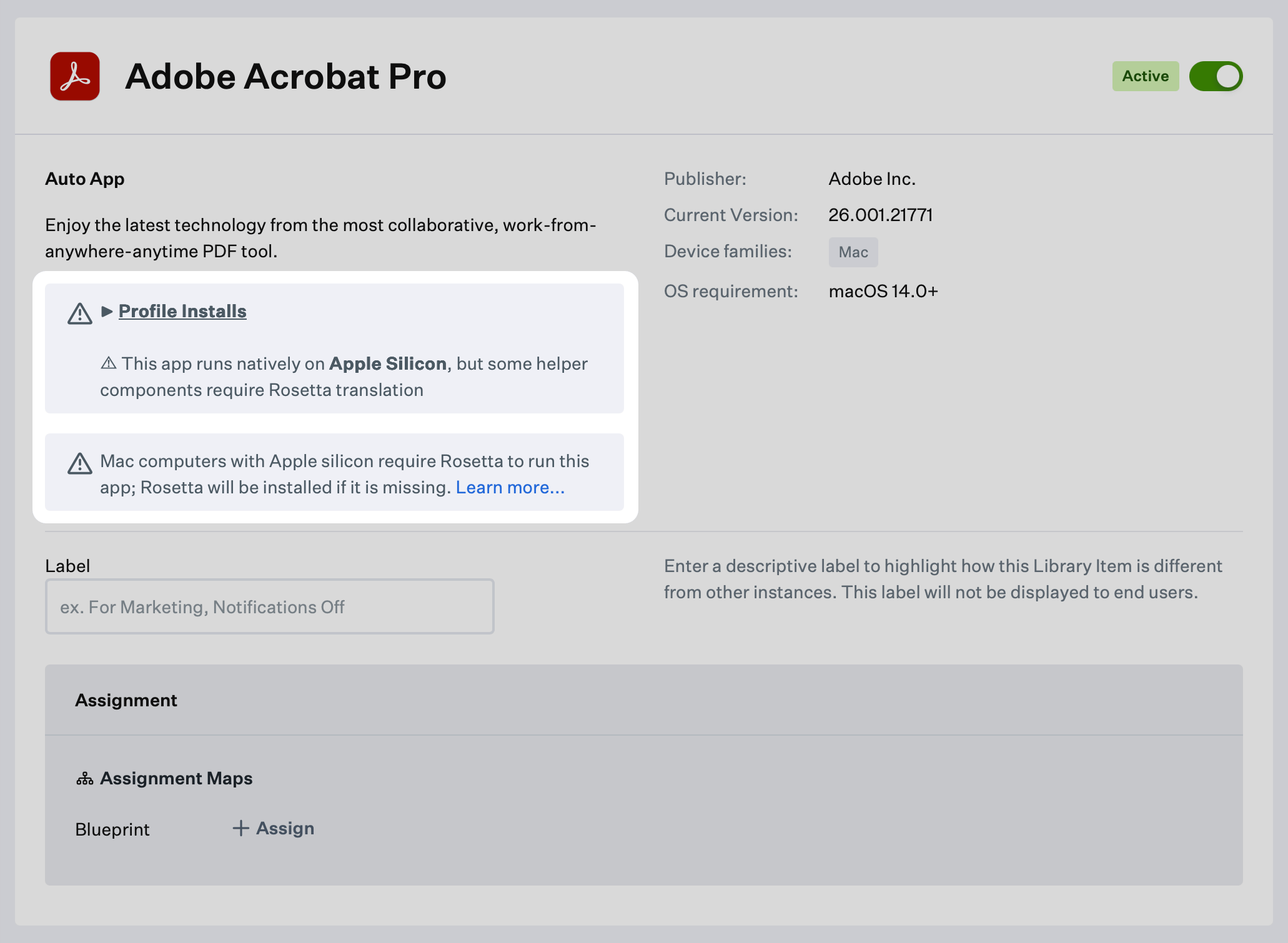
Intel-based Custom Apps require Rosetta 2
As of November 2020, when Apple first introduced computers with Apple silicon, many of the Auto Apps from Iru Endpoint were available only as Intel-based software applications. When a computer with Apple silicon detects an installer package for Intel-based software, it will send that package to the Rosetta 2 translation environment for processing. If Rosetta 2 is not already installed, then one of two things will happen.- If the user opens the installer package, the user will be prompted by the system to install Rosetta 2.
- If Iru Endpoint runs the installer package, the installation will stop because Rosetta 2 is unavailable on the system.
Install Rosetta 2 with Iru Endpoint
To install Intel-based Custom Apps on a computer with Apple silicon, configure its Iru Endpoint Blueprint to install Rosetta 2 first. Add a custom script to the Blueprint and name it 00 Install Rosetta 2 for Apple silicon so it runs before other items. To add this Library Item to your Iru Endpoint Library, follow the steps outlined in the Library Overview article.1
Name the Script
Set the script’s name to 00 Install Rosetta 2 for Apple silicon.
2
Assign to Blueprints
Assign the item to the Blueprints as necessary.
3
Set Execution Frequency
Set the execution frequency to Once per device.
4
Add Script Content
In the script details, paste in the script block that appears below.
5
Save Configuration
Select Save to complete the Custom Script setup.