This Library Item is available for Mac computers
The LAPS (Local Administrator Password Solution) Library Item rotates passwords for the local administrators you define in this Library Item and stores them securely in Iru. Each Mac gets unique passwords for those accounts on a schedule you control, instead of one static admin password across the fleet. LAPS does not create user accounts. It only rotates passwords for existing local administrators. Create those accounts by provisioning a local administrator (Auto Admin) in an Automated Device Enrollment Library Item, or with the Create User Accounts Blueprint Parameter. This Library Item is enforced by the Iru Agent, so it works independently of Apple’s MDM protocol.
You must provide the existing password for each local administrator you define in this Library Item. Iru uses it to preserve SecureToken and volume ownership on Apple silicon.

Create a LAPS Library Item

To add this Library Item to your Iru Endpoint Library, follow the steps outlined in the Library Overview article.
1

Navigate to Library

Navigate to the Library and select Add Library Item.
2

Select LAPS

Search for and select LAPS.
3

Name the Library Item

Give the Library Item a Name.
4

Assign to Blueprints

Assign it to one or more Blueprints.

Configure the LAPS Library Item

These settings control the passwords Iru generates. Configure them using the steps below.
1

Import from Passcode

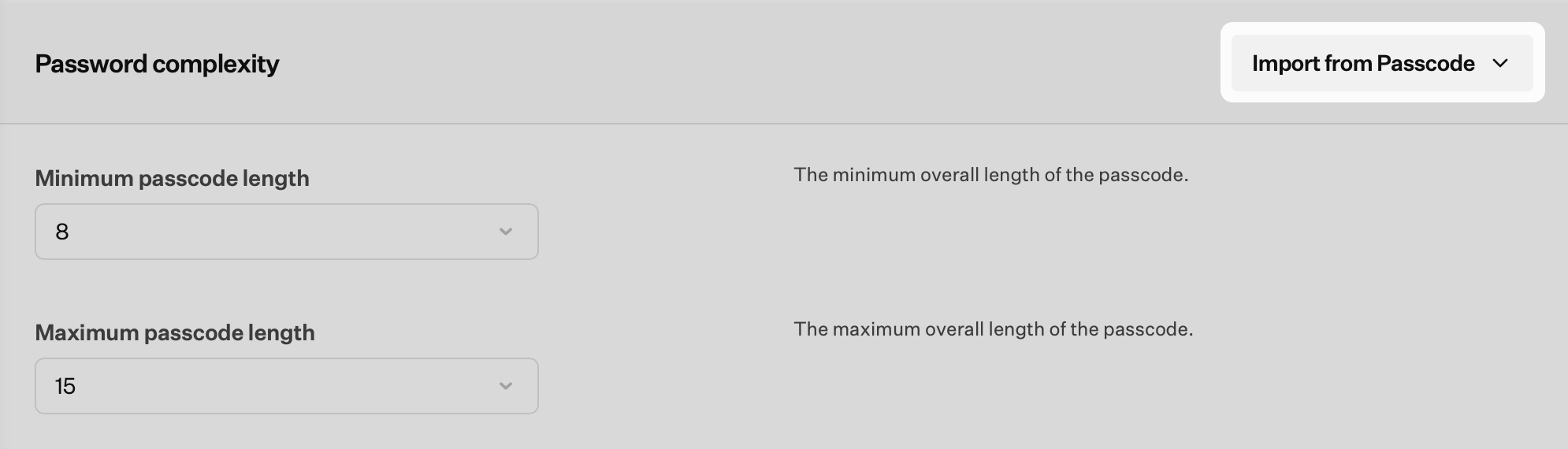
In Password complexity, optionally use Import from Passcode to copy complexity settings from a Passcode Library Item already in your Library. You can import from a Passcode Library Item only, not from Android Work Profile Passcode.
Password complexity section with Import from Passcode
If there is no compatible Passcode Library Item to import from, Import from Passcode is disabled and shows No Library Items available.
macOS requires passwords on the device to comply with the passcode policy, so importing from an existing Passcode Library Item keeps LAPS aligned with that policy.
2

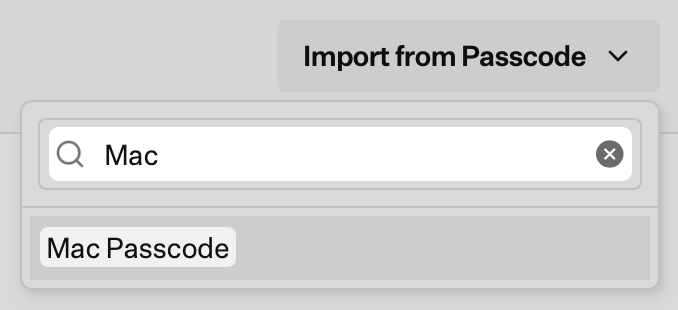
Select a Passcode Library Item

Search by name, then select the Passcode Library Item.
Import from Passcode search with a Passcode Library Item in the results
3

Review imported Passcode settings

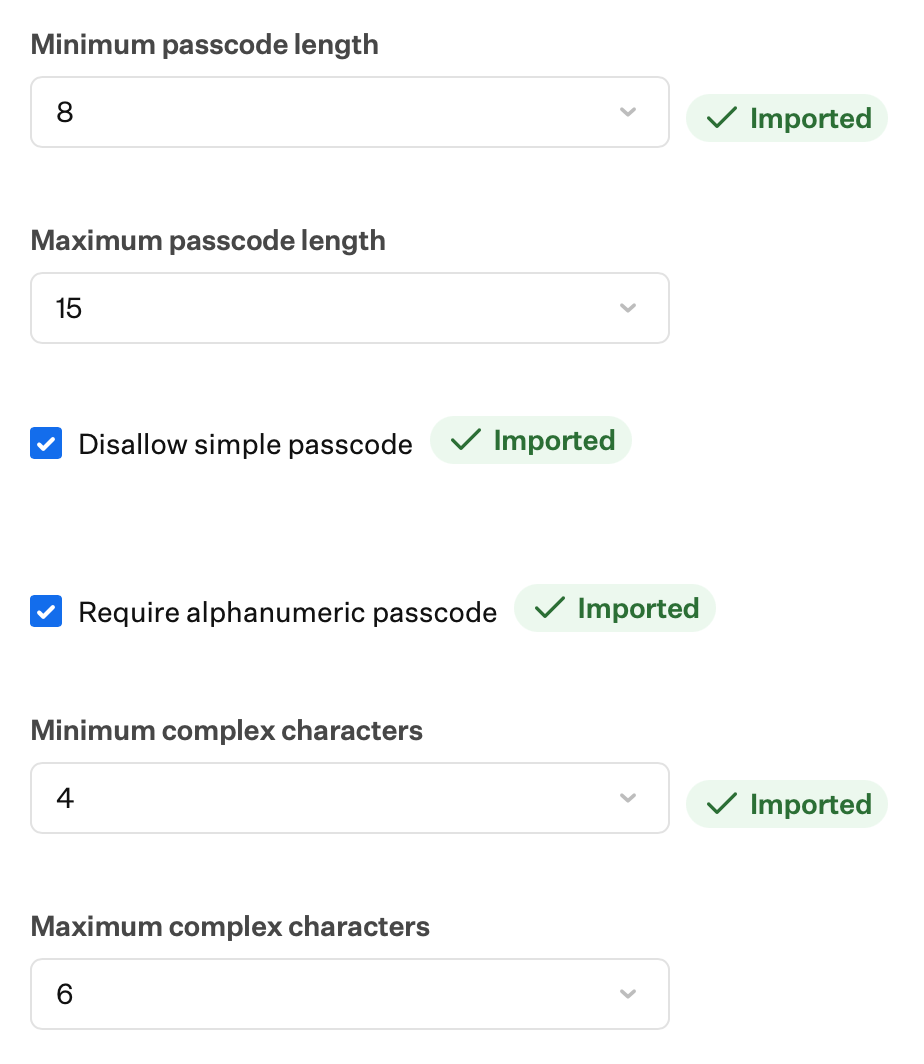
When the import succeeds, matching settings show an Imported badge. You can still change any value after import.
Password complexity settings with Imported badges after importing from Passcode
4

Minimum passcode length

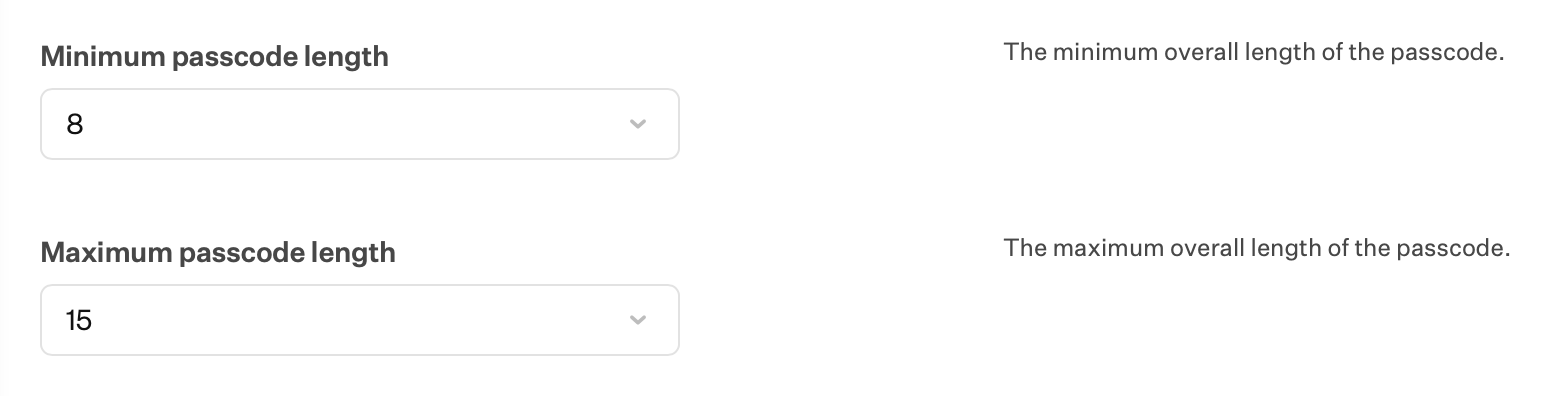
Set Minimum passcode length to the minimum overall length of the passcode. Default: 8. Range: 1 to 36.
5

Maximum passcode length

Set Maximum passcode length to the maximum overall length of the passcode. Default: 15. Range: 1 to 36. Must be at least Minimum passcode length.
Minimum passcode length and Maximum passcode length settings
6

Disallow simple passcode

Select Disallow simple passcode so passcodes cannot have more than two sequential characters (such as 123 or CBA) or more than three repeating characters (such as 111 or AAA). Enabled by default.
7

Require alphanumeric passcode

Select Require alphanumeric passcode to require letters as well as numbers. Enabled by default.
Disallow simple passcode and Require alphanumeric passcode settings
8

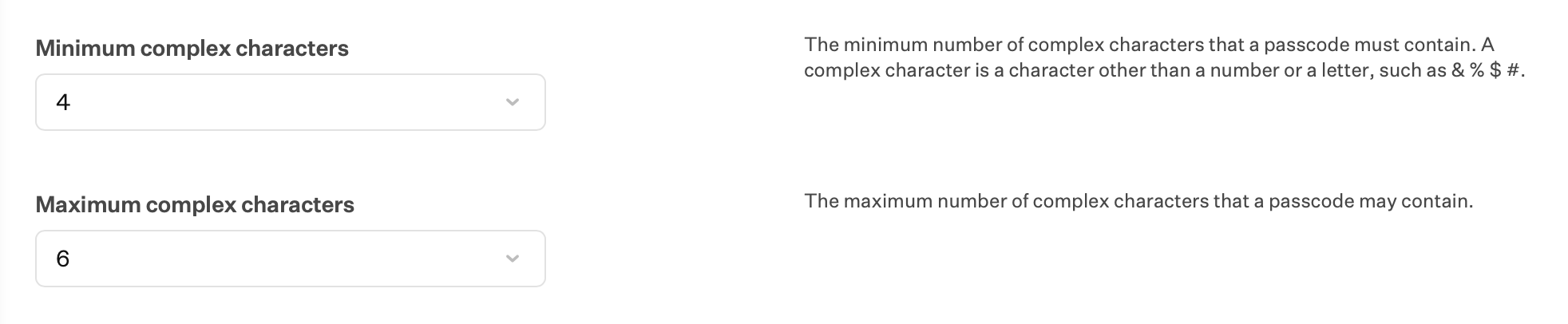
Minimum complex characters

Set Minimum complex characters to the minimum number of complex characters that a passcode must contain. A complex character is a character other than a number or a letter, such as & % $ #. Default: 4. Range: 0 to 36.
9

Maximum complex characters

Set Maximum complex characters to the maximum number of complex characters that a passcode may contain. Default: 6. Range: 1 to 36. Must be at least Minimum complex characters.
Minimum complex characters and Maximum complex characters settings
10

Automatically rotate after (days)

Set Automatically rotate after (days) to how often local admin passwords rotate on devices and are securely stored with Iru, regardless of Automatically rotate after viewing (hours). Range: 1 to 90 days. Default: 30 days.
11

Automatically rotate after viewing (hours)
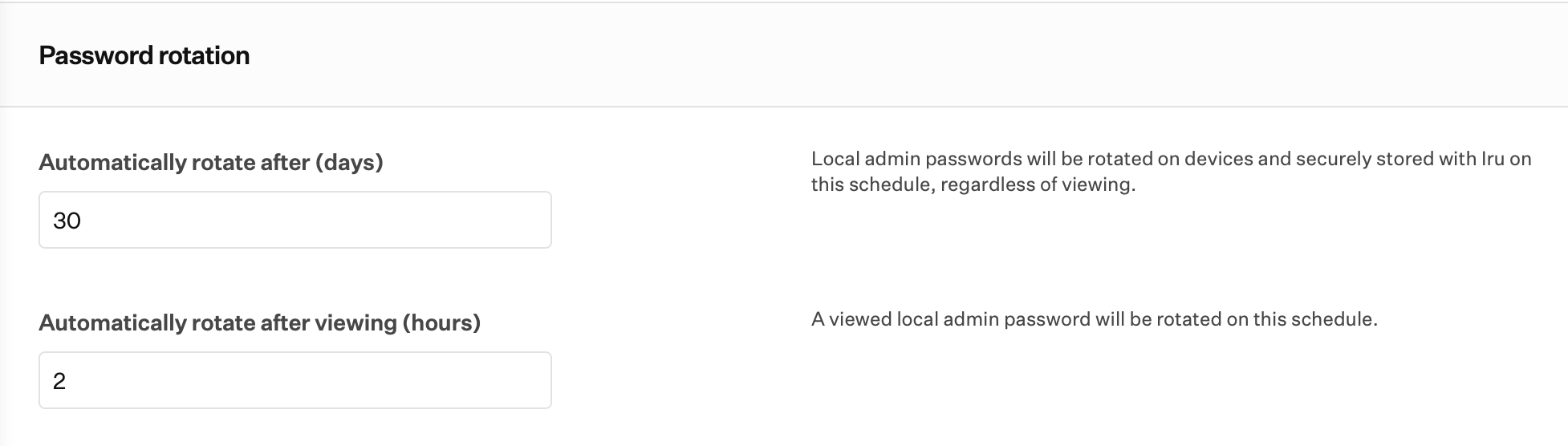
Set Automatically rotate after viewing (hours) to how soon a viewed local admin password rotates. This setting runs independently of Automatically rotate after (days). Range: 1 to 24 hours. Default: 2 hours.
Password rotation settings
12

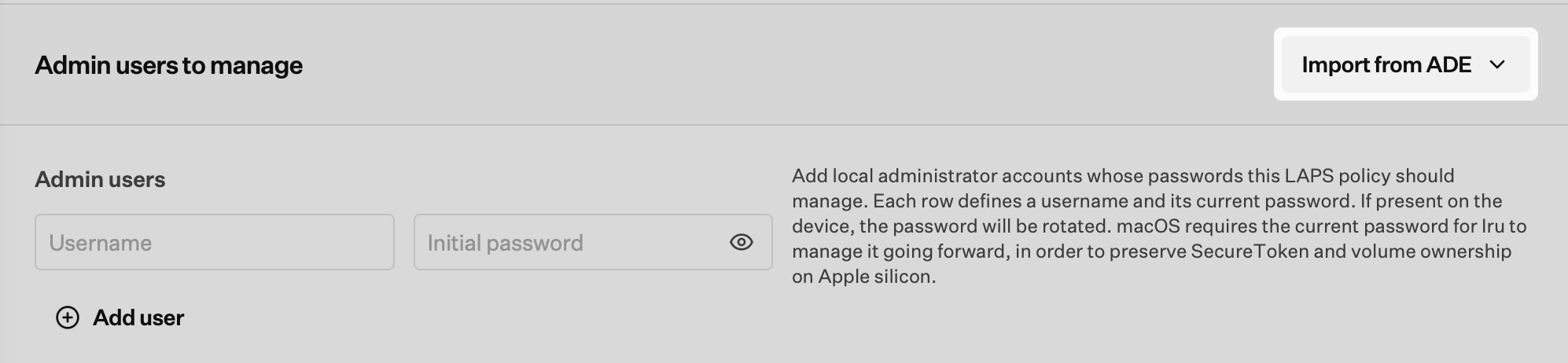
Import from ADE

In Admin users to manage, optionally use Import from ADE to populate accounts from an Automated Device Enrollment integration.
Admin users to manage section with Import from ADE
13

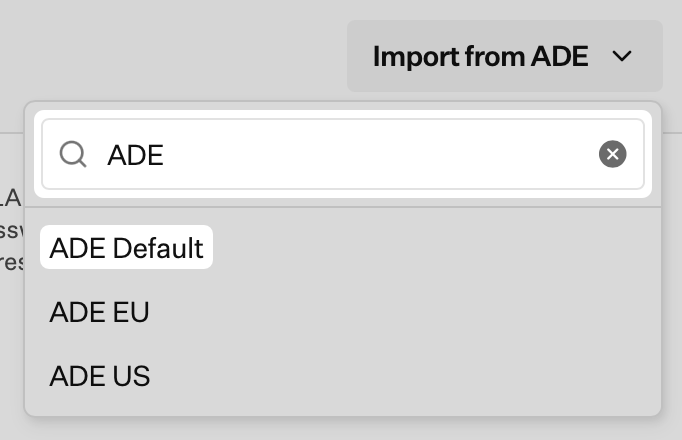
Select an ADE integration

Search by name, then select the ADE integration.
Import from ADE search listing ADE integrations
14

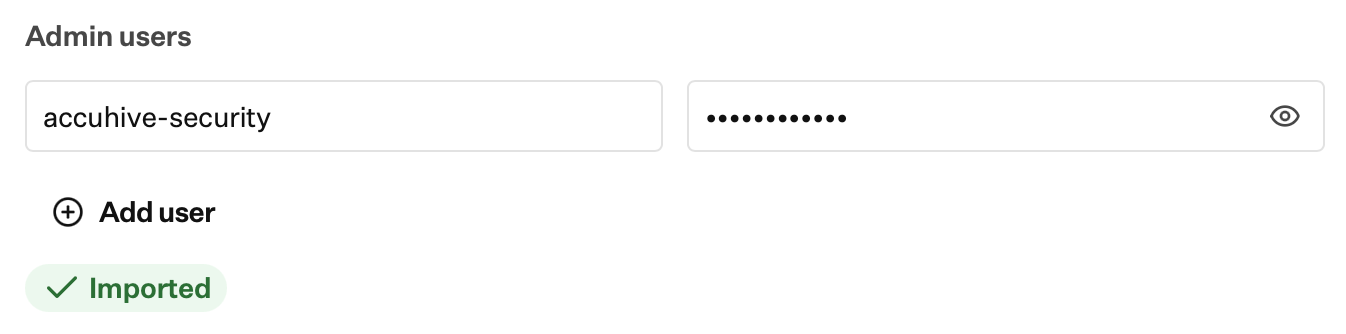
Review imported admin users

When the import succeeds, Iru shows Imported settings from the ADE integration name, and an Imported badge appears below + Add user.
Admin users with an Imported badge after importing from ADE
15

Admin users to manage

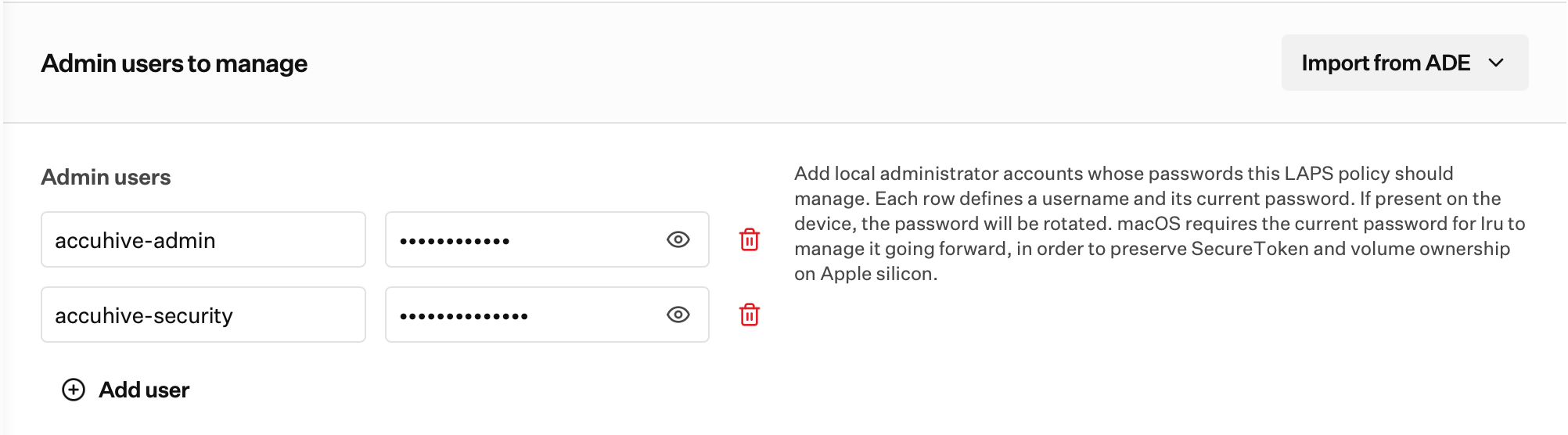
Add local administrator accounts whose passwords this LAPS policy should manage. Each row defines a Username and its Initial password. If the account is present on the device, the password will be rotated.Use + Add user to add another row. Use the trash control on a row to remove it. Use the eye icon on Initial password to show or hide the value while you are setting or updating it.
Admin users to manage with Username and Initial password rows
Passwords in Admin users are only viewable with the eye icon while you are setting the initial value or updating it. After you save, you cannot view the existing password in the Library Item.
16

Update Initial password if it changes outside LAPS

Once a device has had LAPS assigned, you do not need to re-enter the password on later edits to the Library Item. If that account’s initial password changes outside LAPS, such as the password in Automated Device Enrollment or the Create User Accounts Blueprint Parameter, update Initial password here so it matches what is set on the device now.
17

Save

Click Save.

View a device’s password

Help Desk or higher can reveal a LAPS password. Secrets Auditor and Auditor can see that a password exists but cannot reveal it. Displaying a password logs the view and, if a LAPS Library Item is assigned, starts Automatically rotate after viewing (hours).
1

Open the device record

Navigate to Devices in the Iru Endpoint web app and select the Mac.
2

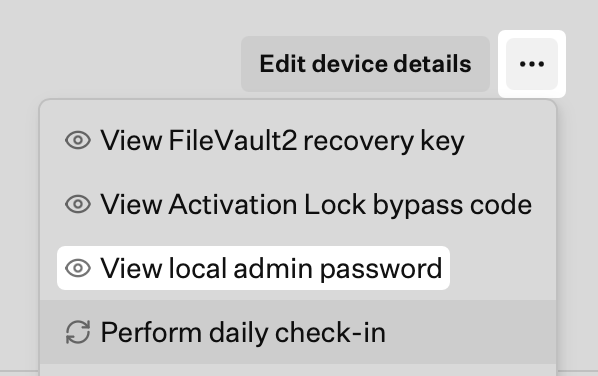
Select View local admin password

Open the Device Action Menu (ellipsis) in the upper right of the device record and select View local admin password. This action is available for any device that has ever had a LAPS password, including a device that is currently erased or locked.
Device Action Menu with View local admin password selected
3

Choose the account

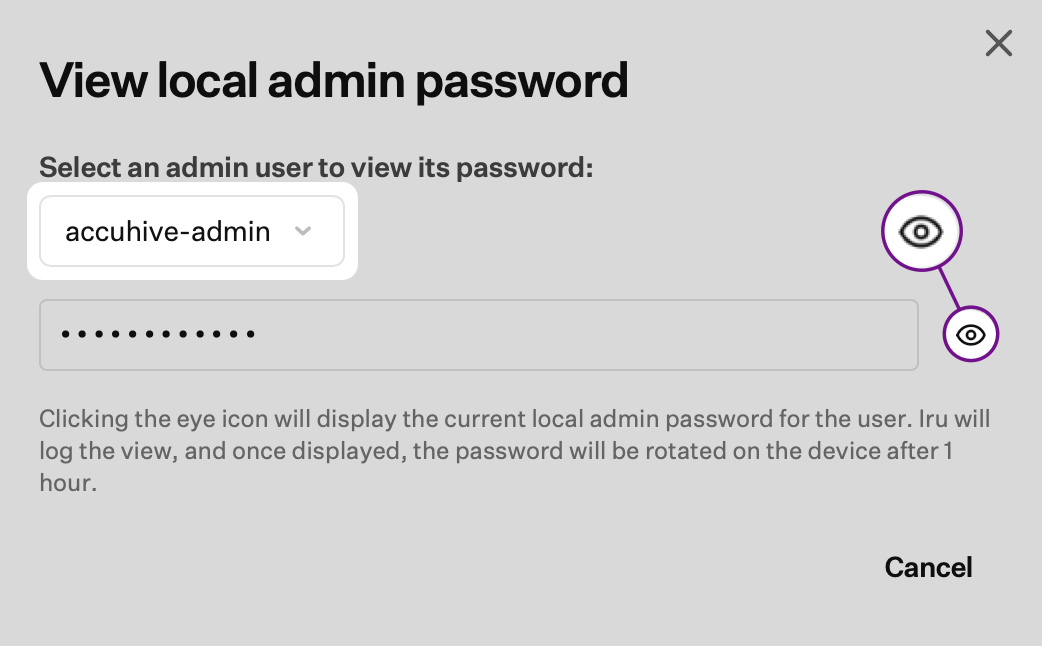
In the View local admin password dialog, use Select an admin user to view its password to choose the account if more than one is managed on the device.
4

Display the password

Click the eye icon to display the current local admin password. That click logs who viewed the password and when, and starts Automatically rotate after viewing (hours). The dialog states that after the password is displayed, it rotates on the device after that configured time.
View local admin password dialog with account selection, eye icon, and Cancel
If no LAPS Library Item is assigned at the time you view, Iru warns that Automatically rotate after viewing (hours) will not apply. The view is still logged.
5

Hide the password

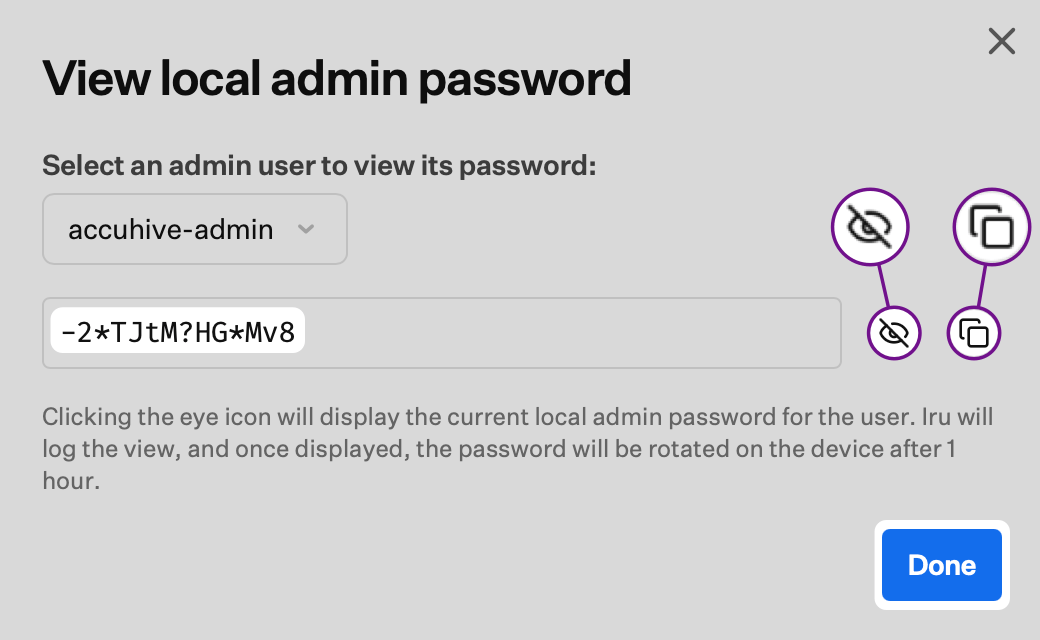
After the password is displayed, click the eye icon with a line through it to hide the password.
6

Copy the password

Click the copy icon to copy the password.
7

Click Done

Click Done when you are finished.
View local admin password dialog after display, with hide and copy

View activity records

Local admin password activity is recorded on the device record Activity tab and in Unified Activity. These events do not appear on the Activity Page.

Device record

On the device record Activity tab, Iru records when a local admin password is viewed, rotated, or fails to rotate.
1

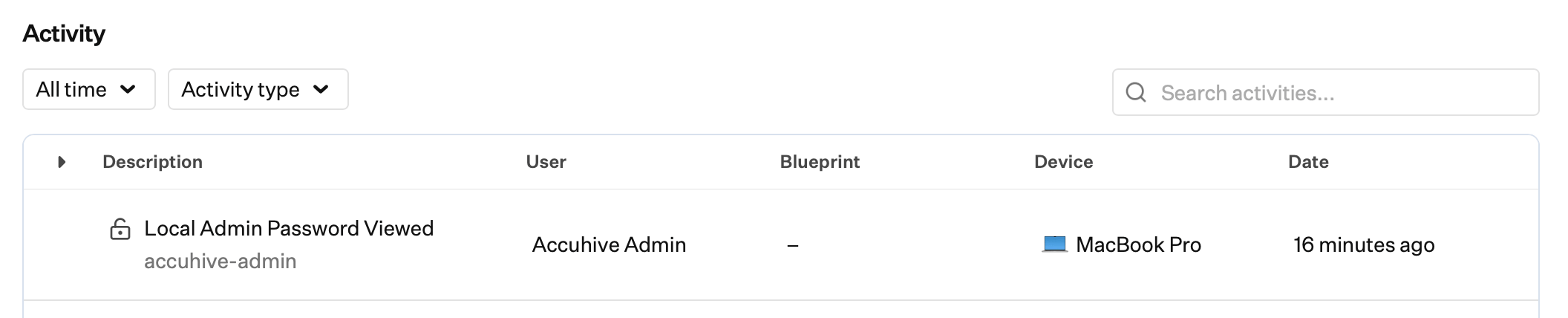
Review Local Admin Password Viewed

A Local Admin Password Viewed entry shows the local admin username, who viewed the password, the device, and when.
Device record Activity showing Local Admin Password Viewed
2

Review Local Admin Password Rotated

A Local Admin Password Rotated entry shows the local admin username, the Blueprint, the device, and when.
Device record Activity showing Local Admin Password Rotated
3

Review Local Admin Password Rotation Failed

A Local Admin Password Rotation Failed entry shows the local admin username, a reason, the Blueprint, the device, and when.
Device record Activity showing Local Admin Password Rotation Failed

Unified Activity

Unified Activity records when a local admin password is viewed and when it is updated, including success and failure.
1

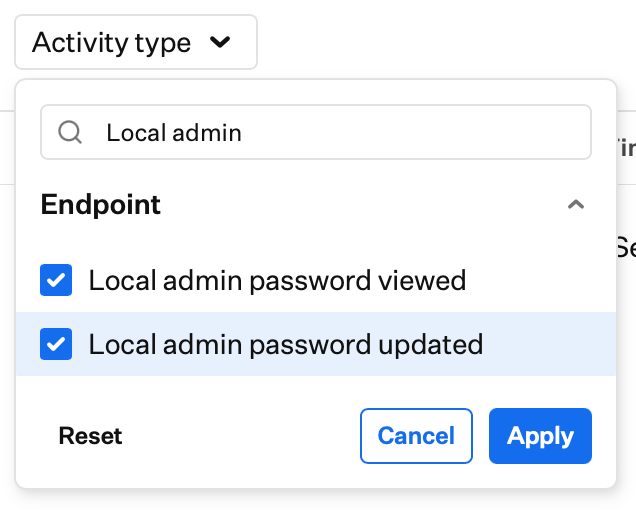
Filter Unified Activity

In Unified Activity, open Activity type, search Local admin, and under Endpoint select Local admin password viewed, Local admin password updated, or both. Click Apply.
Unified Activity type filter for Local admin password viewed and Local admin password updated
2

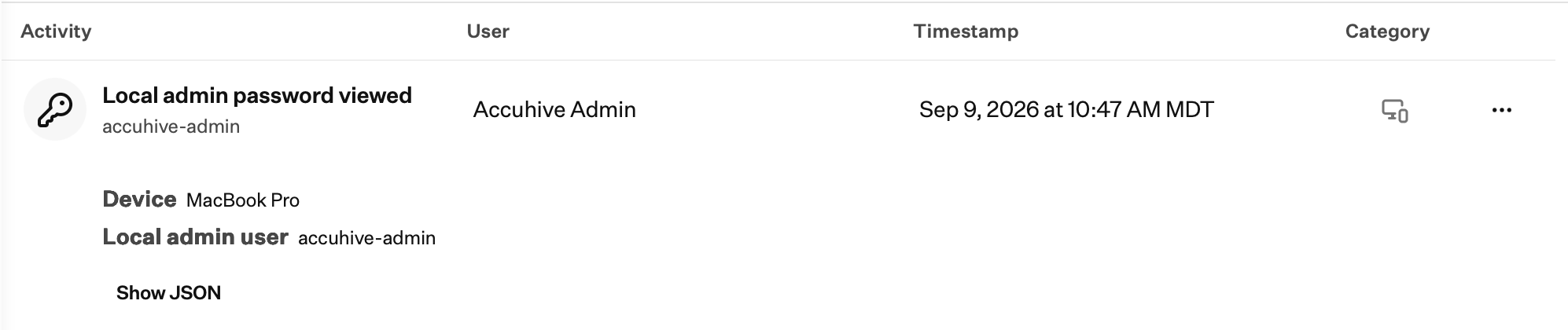
Review Local admin password viewed

A Local admin password viewed entry shows the local admin username, who viewed the password, and when.
Unified Activity showing Local admin password viewed
3

Review Local admin password updated

Expand a Local admin password updated entry. A successful rotation shows Rotated for the local admin username. Details include Device, Local admin user, Outcome (Local admin password rotated), and Completed at.
Unified Activity showing Local admin password updated after a successful rotation
4

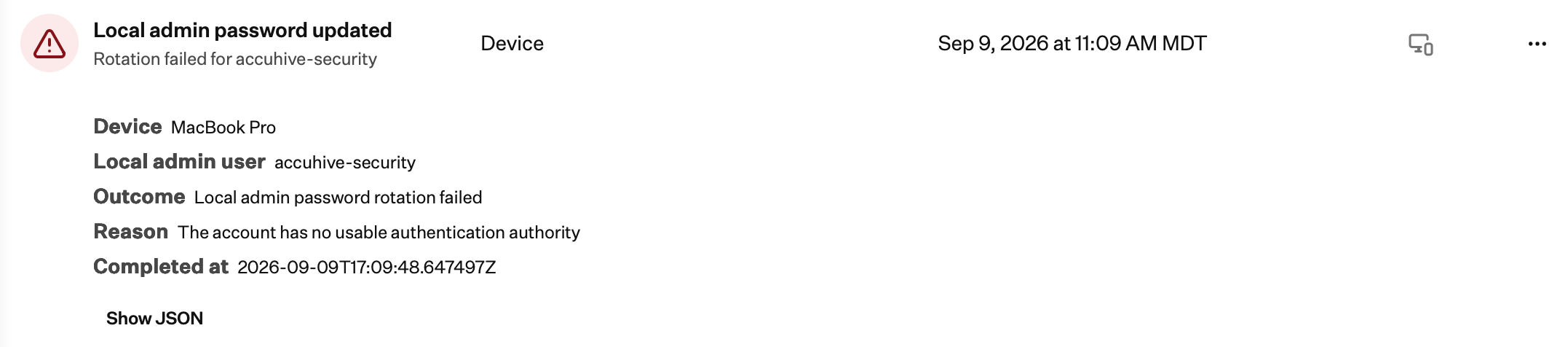
Review a failed rotation

A failed rotation uses the same Local admin password updated activity type. It shows Rotation failed for the local admin username. Details include Outcome (Local admin password rotation failed) and Reason.
Unified Activity showing Local admin password updated when rotation failed
5

Go to device

Click the ellipsis () next to the activity entry and select Go to device to open the related device record.

Considerations

Admin accounts only

LAPS only manages local administrator accounts. Standard accounts are rejected with an error.

One LAPS Library Item per device

A device can have one LAPS Library Item assigned. Assigning a second Library Item is not supported.

Current password is required

You must provide the existing password for each local administrator you define in this Library Item. Iru uses it to preserve SecureToken and volume ownership on Apple silicon. If Iru’s record of a device’s current password falls out of sync, contact Iru Support. Without SecureToken, that account cannot unlock FileVault after a restart.

Re-enrollment rotates at the next check-in

Re-enrolling a device rotates its password at the next check-in, not on whatever was left of Automatically rotate after (days).

Set Auto Admin Password is unavailable

The Set Auto Admin Account Password device action is not available when LAPS is assigned. LAPS manages that password.

Who can reveal a password

Help Desk or higher can reveal a LAPS password. Secrets Auditor and Auditor cannot. Displaying a password starts Automatically rotate after viewing (hours) only if a LAPS Library Item is assigned.

Best Practices

1

Reuse your Passcode settings

Import complexity settings from an existing Passcode Library Item if you have already tuned them, so LAPS and Passcode stay consistent.
2

Match your compliance requirements

Use Automatically rotate after (days) and Automatically rotate after viewing (hours) to balance convenience against how long a viewed password remains valid.
3

Review rotation activity

When a password fails to rotate, check the Reason field in Unified Activity or the device record Activity tab. Most failures state the cause directly.

Troubleshooting

Possible causes:
  • The ADE integration does not define a local administrator account
Solutions:
Possible causes:
  • You already imported from that ADE integration
  • You added the same username manually
Solutions:
  • Keep the existing row. Iru does not add a duplicate.
When a password fails to rotate, check Reason in Unified Activity (Reason: <cause>) or the device record Activity tab (<username>: <cause>).Possible causes:
  • The Reason field names the cause, such as a locked keychain
  • The account is not a local administrator
  • Iru’s stored current password does not match the device
Solutions:
  • Confirm the account is an administrator. LAPS does not manage standard accounts
  • There is no automatic retry. The next attempt follows Automatically rotate after (days)
  • If the stored password is out of sync, contact Iru Support
Possible causes:
  • No LAPS Library Item was assigned to the device at the time of viewing
Solutions:
  • Assign a LAPS Library Item if you want Automatically rotate after viewing (hours) and Automatically rotate after (days) going forward
  • The view is still logged even when Automatically rotate after viewing (hours) does not start
Possible causes:
  • LAPS is assigned to this device, so the conflicting MDM command is hidden
Solutions:
  • Expected when LAPS is assigned. Use View local admin password instead
  • Remove LAPS from the device’s Blueprint only if you need the Set Auto Admin Password action
Possible causes:
  • The account is not an administrator
  • The account is not present on the device
  • The current password in the Library Item does not match the account on the device
Solutions:
  • Confirm the account is a local administrator
  • Confirm the username matches the account on the Mac
  • Provide the current password on first assignment so Iru can take over the account

Library Overview

Curate, create, and manage Library Items and add them to Blueprints.

Iru Agent and MDM

LAPS is agent-based, so it works independently of Apple’s MDM protocol.

Unified Activity

Local admin password viewed and updated events appear in Unified Activity, not on the Activity Page.

Create User Accounts

Create local administrator accounts for LAPS to rotate. LAPS does not create accounts.

Configure the Passcode Library Item

Enforce passcode requirements, including settings you can import into LAPS.

Configure the Recovery Password Library Item

Configure recovery passwords on Mac computers with Apple silicon and Intel.

Set the Auto Admin Account Password

The MDM command LAPS replaces while it is assigned.

Configure Automated Device Enrollment

ADE integrations you can import admin accounts from.

Configure FileVault

FileVault encryption and recovery keys on Mac computers.