

Generate an API Token
Iru Endpoint uses tenant-level bearer tokens to control access to the API. To generate one:1
Open Access
In the sidebar, select the Account Menu Button, then select Access.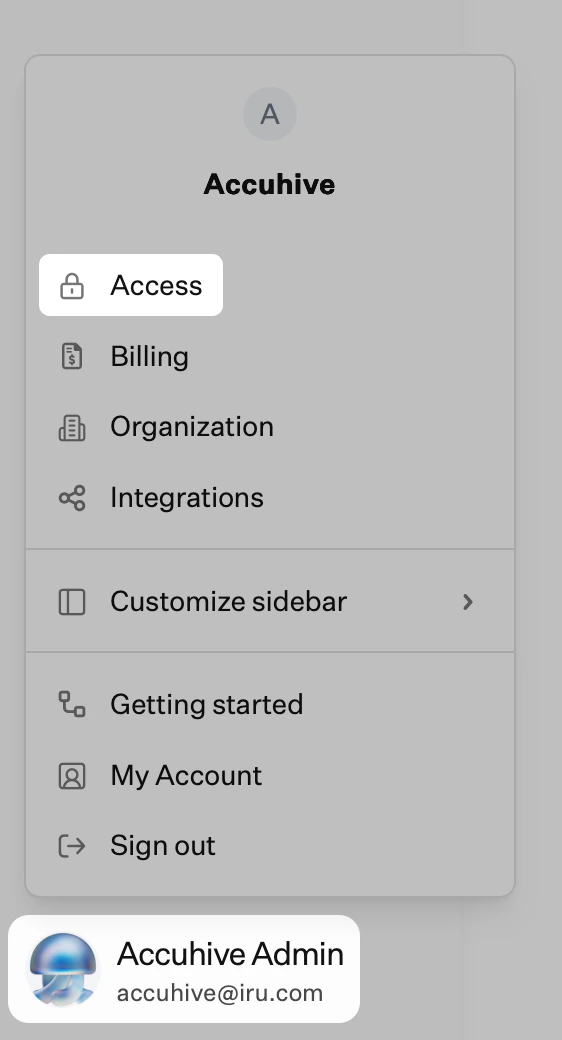
2
Open the API tokens tab
In Access, select the API tokens tab.
3
Note your organization's API URL
On the API tokens page, look for Your organization’s API URL. The line shows your tenant hostname in this form (your value will differ):Your organization’s API URL is:
accuhive.api.kandji.ioMake a note of this hostname. You use it with the Iru Endpoint API and your bearer token.4
Create new API token
Select Add Token to create a new API token.
5
Configure token details
Provide a Name and a Description for your API token.
6
Enable MCP (optional)
If you want this token to work with Model Context Protocol (MCP) clients (for example Cursor, Claude Desktop, or OpenAI Codex), turn on Enable MCP. See Iru MCP for MCP configuration, permissions, and supported clients.
7
Create the token
Select Create.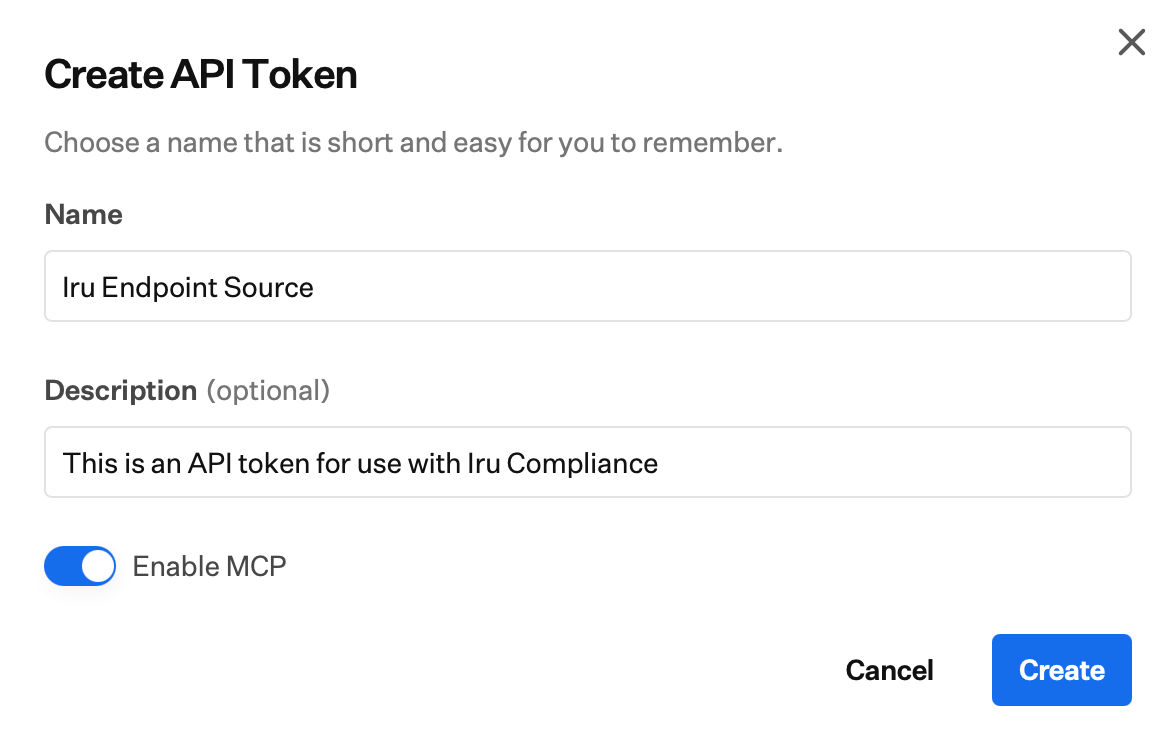
8
Copy and store token
Iru Endpoint will display a modal with the API token. Select the visibility symbol to expose it or use the Copy Token button to copy the API token to your clipboard, storing it in a safe place.If you turned on Enable MCP, the same one-time success screen also shows an MCP configuration block next to the token. Use Copy MCP configuration to copy the JSON snippet (your MCP URL and the values an MCP client uses to authenticate) and store it alongside the token. See Iru MCP for how to use that snippet in Cursor, Claude Desktop, or other supported clients.
You will not be able to see the token or the MCP configuration again.
9
Continue to next step
Select Next.
10
Configure permissions
Select Configure to manage the API permissions for this specific token or Skip to change them later.
11
Choose API permissions
Check or uncheck the box next to each permission you want to change. If you check or uncheck the box at the top of a section (for example Blueprints Management), every permission in that section is checked or unchecked together.
12
Save configuration
After making your modifications, select Save.
Edit Token
1
View token details
On the API tokens page, select a token name, or select the vertical ellipsis and then View, to open that token and its permissions.
2
Edit permissions
Select Edit to change the token’s API permissions. If none are assigned yet, you can use Configure Permissions instead. Edit works whether the token already has permissions or not.
3
Choose API permissions
Check or uncheck the box next to each permission you want to change. If you check or uncheck the box at the top of a section (for example Blueprints Management), every permission in that section is checked or unchecked together.
4
Save permission changes
Select Save.
View Activity
The Unified Activity timeline lists tenant-wide API token activity: API token created, API token updated, and API token deleted. Filter by Activity type to narrow the timeline. The steps below show token-specific activity on the token detail page.1
View token details
On the API tokens page, select a token name, or select the vertical ellipsis and then View, to open that token and its permissions.
2
Open the Activity tab
Select the Activity tab. The timeline lists lifecycle events and API usage.
3
Expand an activity entry
In the timeline, select a row to expand it and read its fields.
- Chevron, event icon, title, actor (admin display name or a dash when there is no administrator), short date (
M/D/YY).
- Expanded rows show full timestamps (
M/D/YY, h:mm:ss AMorPM) for time fields, plus the event-specific fields in each accordion below.
Token created
Token created
Summary: Key icon, Token created, creator display name, short date (
M/D/YY).Expanded- Created by: same display name as the summary row.
- Created at: when the token was created.
Token name changed
Token name changed
Summary: Icon, Token name changed, editor display name, short date (
M/D/YY).Expanded- Same administrator by / at layout as Token created and Token permissions edited: who renamed the token and when.
Token permissions edited
Token permissions edited
Summary: Padlock icon, Token permissions edited, editor display name, short date (
M/D/YY).Expanded- Edited by and Edited at (who saved the change and when).
- Permissions enabled: one
METHOD /pathper line for permissions turned on in that save (for exampleGET /blueprint-routing,PATCH /blueprint-routing). - Permissions disabled: same format for permissions turned off (for example
GET /devices-list). - One save can list routes under both sections. If nothing was turned on or off in that save, the matching section has no lines.
Token accessed
Token accessed
Summary: Eye icon, Token accessed, dash in the actor column (no admin; the client used the token), short date (
M/D/YY).Expanded- Accessed by: the caller’s public IPv4 address.
- Accessed at: when the token was used.
- Endpoints accessed: one or more lines, each
METHOD /path(for exampleGET /devices-list).
Revoke a Token
Revoking stops the token from working with the Management API. If Enable MCP was on for that token, this access is also disabled when the token is revoked. See Iru MCP for MCP client configuration.Revoking a token removes all Activity recorded for that token. That history cannot be recovered.
1
Start revocation
On the API tokens page, select the vertical ellipsis next to the token you want to revoke, then select Revoke. Or open the token, select Edit, then Revoke at the bottom left.
2
Enter the token name
Enter the token name exactly as it appears in the prompt.
3
Confirm revocation
Select Revoke to confirm.
After revocation, the token disappears from the list and you can’t review its Activity anymore.
Best Practices
One token per integration
Create a unique API token for each integration or use case so you can rotate or revoke one connection without affecting others.
Clear names and descriptions
Use clear, descriptive Name and Description values in the Iru Endpoint Web App so tokens are easy to recognize on the API tokens page in Access.
Considerations
Removed administrators and API tokens
Removed administrators and API tokens
If you remove an administrator from the Iru Endpoint Web App, API tokens they created stay in place and keep working until they are revoked. Deleting the user does not automatically revoke those tokens. Open Access, go to API tokens, and Revoke (or rotate by creating a new token and revoking the old one) if you need to stop access.Anyone with permission to use the Access page can manage every API token in the tenant: edit Permissions, rename the token, review Activity, and revoke it. You do not need to be the user who originally created the token.The secret (the string you use as a bearer token) is shown only once, when the token is first created. After that, other administrators can still administer the token in Access, but they cannot see that secret again unless the creator shared it with them at creation time (for example in a password manager or secure message). Anyone with Access can still revoke the token or narrow its permissions if the secret might have been exposed.
Rate limits
Rate limits
The Iru Endpoint Management API currently has an API rate limit of 10,000 requests per hour per customer, documented in the introduction of the Iru Endpoint Management API documentation.When Iru Compliance collects evidence through the Iru Endpoint Compliance source, it calls the Management API with your API token. Those requests count toward the same hourly limit for your tenant.
Troubleshooting
API rate limit exceeded
API rate limit exceeded
The Iru Endpoint Management API enforces 10,000 requests per hour per customer (see Considerations and the Iru Endpoint Management API documentation). All API tokens in your tenant share that same limit. There is no separate rate limit per token.When a request is blocked for exceeding the limit, the response body includes:To see whether a specific integration or script is driving volume, open Access, select each token, and review Activity for that token (View Activity). Expanding Token accessed entries shows which endpoints were called so you can throttle or fix the client, rotate credentials, or adjust automation as needed.
Token permissions
Token permissions
If the token does not have the API permissions required for the endpoint you are calling, you may receive a response like:In Access, open the token, select Edit, and enable the permissions that match the routes your integration uses (Edit token).
Related Articles
Iru Endpoint Management API reference
Browse endpoints, parameters, and request and response examples.
Integrating Third-Party Apps Using the Iru Endpoint API
Connect third-party products and map the API permissions each one needs.
How to Set Up the Iru Endpoint API in Postman
Import the published collection and send authenticated requests.
Iru Endpoint (Compliance source)
How Iru Compliance uses your token on the Management API for evidence.
Configuring the In-House App Library Item
Publish and update in-house apps using the API and the Web App.
Prism Data Analytics
Query and export fleet data with Prism’s API-first analytics workflows.
Renew, update, or delete ADE tokens using the Iru Endpoint API
Renew, update, or delete ADE tokens using an API token from Access.
Configure multiple ADE tokens using the Iru Endpoint API
Connect multiple Apple Business or Apple School Manager accounts or organizational units to Iru Endpoint.
Authorize Your Iru Tenant for Okta Workflows
Connect Okta Workflows to Iru Endpoint with an API token and device permissions.
Amazon S3 Activity Log Integration
Deliver tenant activity logs to Amazon S3 and review logged event types in the API documentation.