

This Library Item is available for Android devices
Create & Deploy a Google Play App
Add a Google Play app to the Iru Endpoint Library from the managed Google Play iframe, then open it for configuration. Managed Google Play apps can only be deployed to the work profile.1
Navigate to Library
Navigate to the Iru Endpoint Library.
2
Add Library Item
Select Add Library Item in the upper-right corner.
3
Select Google Play Apps
Select Google Play apps on the left-side navigation bar.
4
Search for Application
Search managed Google Play for your application.
5
View App Details
Select the application to load the app details view.
6
Select Application
Select Select to add the application to the Iru Endpoint Library.
7
View Library Item
Select View Library Item to view application configuration options. You can also select Continue Adding to remain in the managed Google Play iframe and search for additional apps.
8
Edit Configuration
Select Edit in the lower-right corner to configure the application.
Configure Google Play app settings
After you select Edit, set a label and Blueprint assignment, then configure Installation, Options, Permissions, and Configurations. Which settings appear can depend on what the app supports in Google Play. Select Save when you finish.1
Set a Label (optional)
Enter a Label to distinguish this Library Item from other instances of the same app. The label is for admins only and is not shown to end users.
2
Assign to Blueprints
Under Assignment Maps, select + Assign to assign the Library Item to one or more Blueprints. You can use Assignment Maps for conditional logic if needed.
3
Configure Installation
Specify how the Google Play app is installed:
- Install and continuously enforce: Force the app install and prevent user removal.
- Install on-demand from Managed Google Play: Allow end users to install the app manually from Managed Google Play.
4
Configure Automatic updates
In Options, under Automatic updates, choose how the app updates:
- Low priority: Update automatically when the device is idle, charging, and connected to an unmetered network.
- High priority: Update as soon as possible with no constraints.
- Delayed: Postpone automatic updates by 90 days. End users can still update the app on demand.
5
Allow as credential manager
Still in Options, select Allow as credential manager to allow this app to act as a credential manager (such as a password manager or passkey provider) in the work profile, even when the Android Restrictions Library Item blocks it.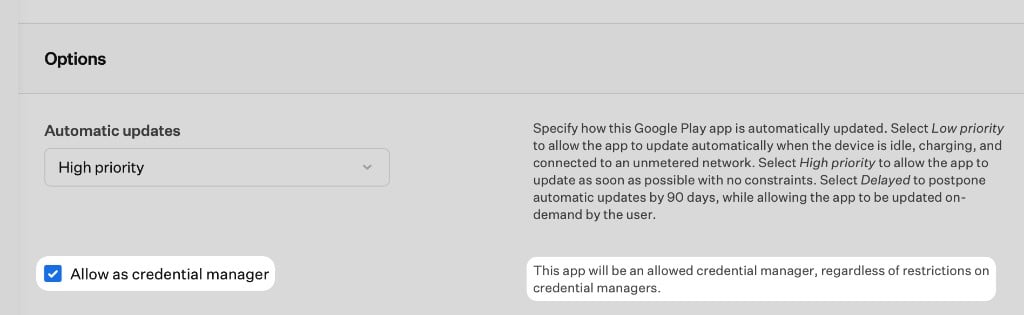
6
Configure Permissions
Set how the app handles runtime permission requests:
- Set default permission policy: Choose the default response for permission requests from this app: Prompt, Grant, or Deny.
- Manage specific permissions: Set a response for individual permissions. Requires Android API level 24 or higher. Select + Add permissions, choose permissions in the picker (search or Select all), then select Done. For each permission, choose Prompt, Grant, or Deny.
7
Configure Configurations
If the app supports managed configurations, set them under Configurations:
- Select configurations: Choose supported configuration keys, then set values for each.
- Enter JSON configuration: Paste or edit the raw JSON configuration.
8
Save
Select Save to deploy the Library Item to assigned devices.