Use this file to discover all available pages before exploring further.
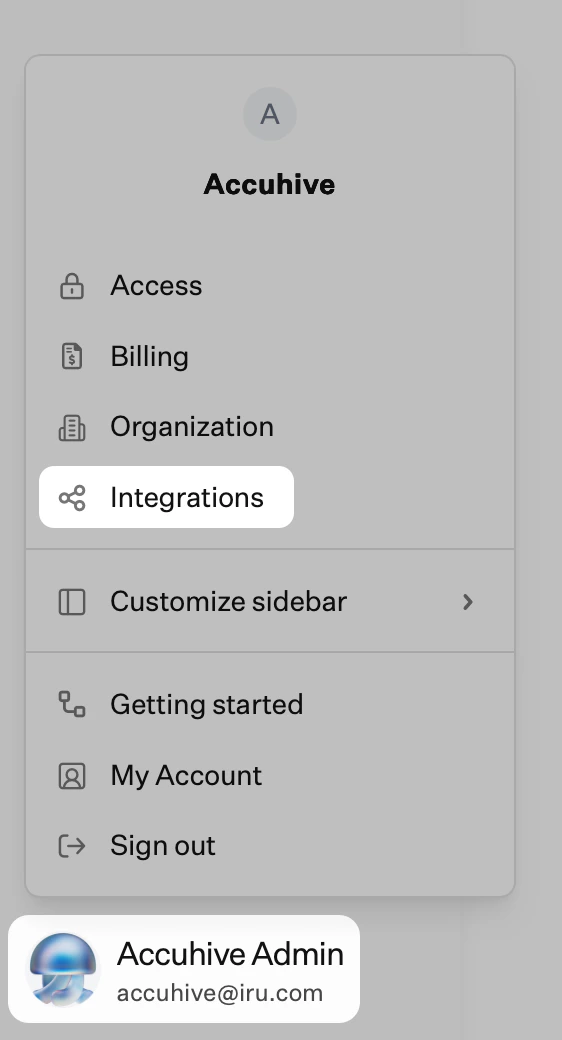
The AD CS integration is configured from the Iru Endpoint Integrations page in your Iru Endpoint web app. Once setup is complete, you can manage Iru Endpoint AD CS Connector servers, add your AD CS Certification Authority (CA) hosts, and create Library Items, all from the AD CS integration page.
Confirm the following before you run the AD CS integration wizard in the Iru Endpoint web app.
Computer certificate template in AD CS
Create a computer certificate template in AD CS for use with Iru Endpoint before you rely on the Connector host for enrollment.
Access to the Connector Windows Server
Ensure you can sign in to the Windows Server designated as the AD CS Connector and transfer or run the installer when the wizard finishes.
Network paths and firewall rules
Firewall and proxy rules must allow the paths in Using Iru on Enterprise Networks under AD CS Integration Network Requirements. The updated Connector uses Iru sign-in (not Auth0). Allow your Iru web app, Iru Identity, tenant API (subdomain.gateway.iru.com, subdomain.gateway.eu.iru.com, subdomain.clients.*), and adcsconn as documented there. Your network must allow traffic between Iru Endpoint, the Connector host, and AD CS, including HTTPS from the Connector to Iru Endpoint without SSL inspection breaking that path when inspection is in use.
Legacy Connector still on the network
If the legacy Connector still runs on some hosts until you finish upgrading them, keep the legacy Auth0 allowlist rows from that same article until those hosts run the updated Connector.
Connector host: OS, .NET, TPM, WebView, domain
The Connector host must meet Windows Server 2019 or higher, .NET 8 or later, TPM or vTPM, WebView2 (bundled with the installer), and domain membership in the forest your issuing CAs serve. For the full checklist, see AD CS Connector Server Requirements in AD CS Connector Installation.
Windows Server ready for the wizard
Have the Windows Server online so you can install the AD CS Connector as soon as you finish the steps in AD CS Integration Setup below.
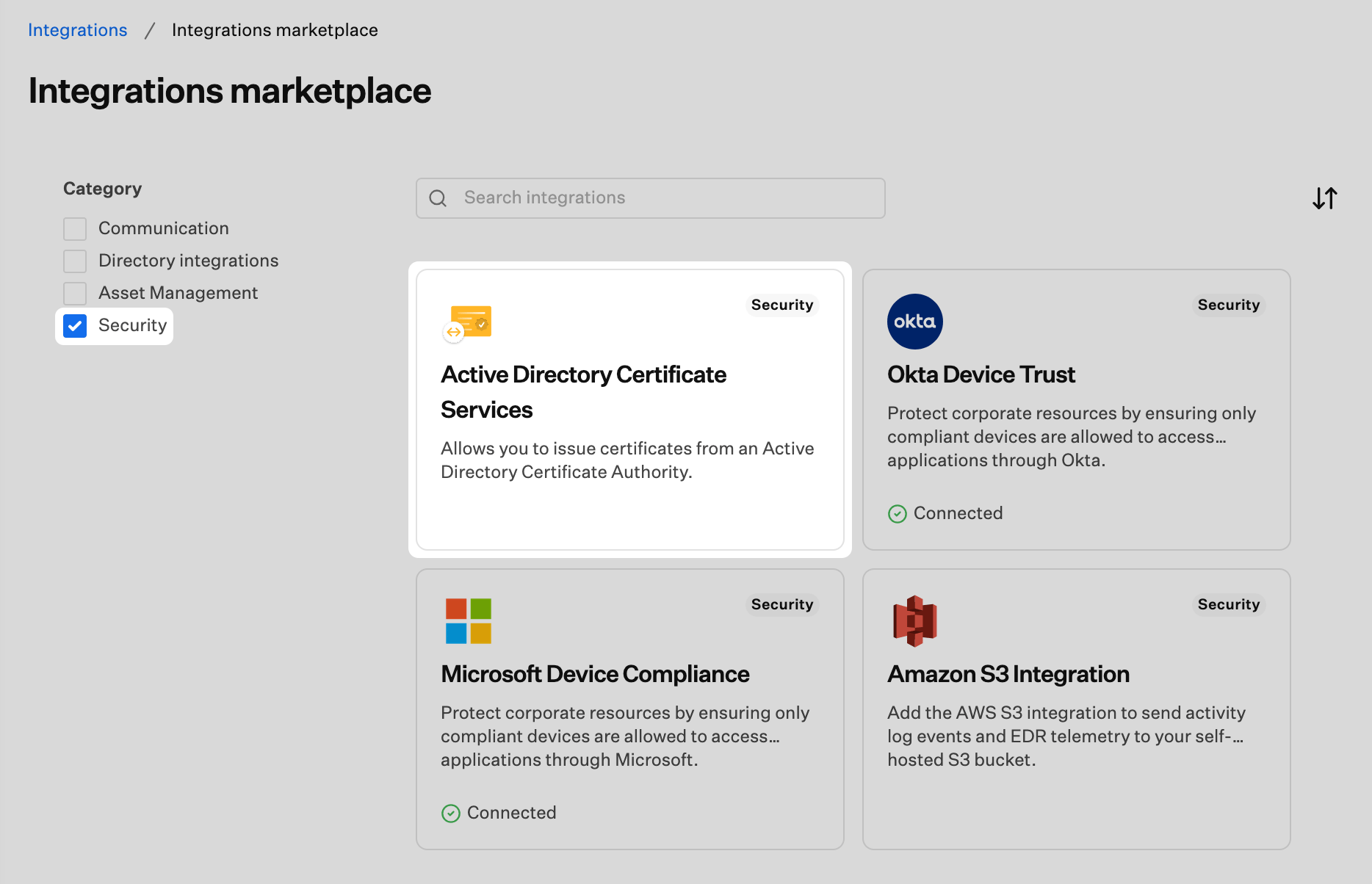
Find the Active Directory Certificate Services integration and click Add and configure.
4
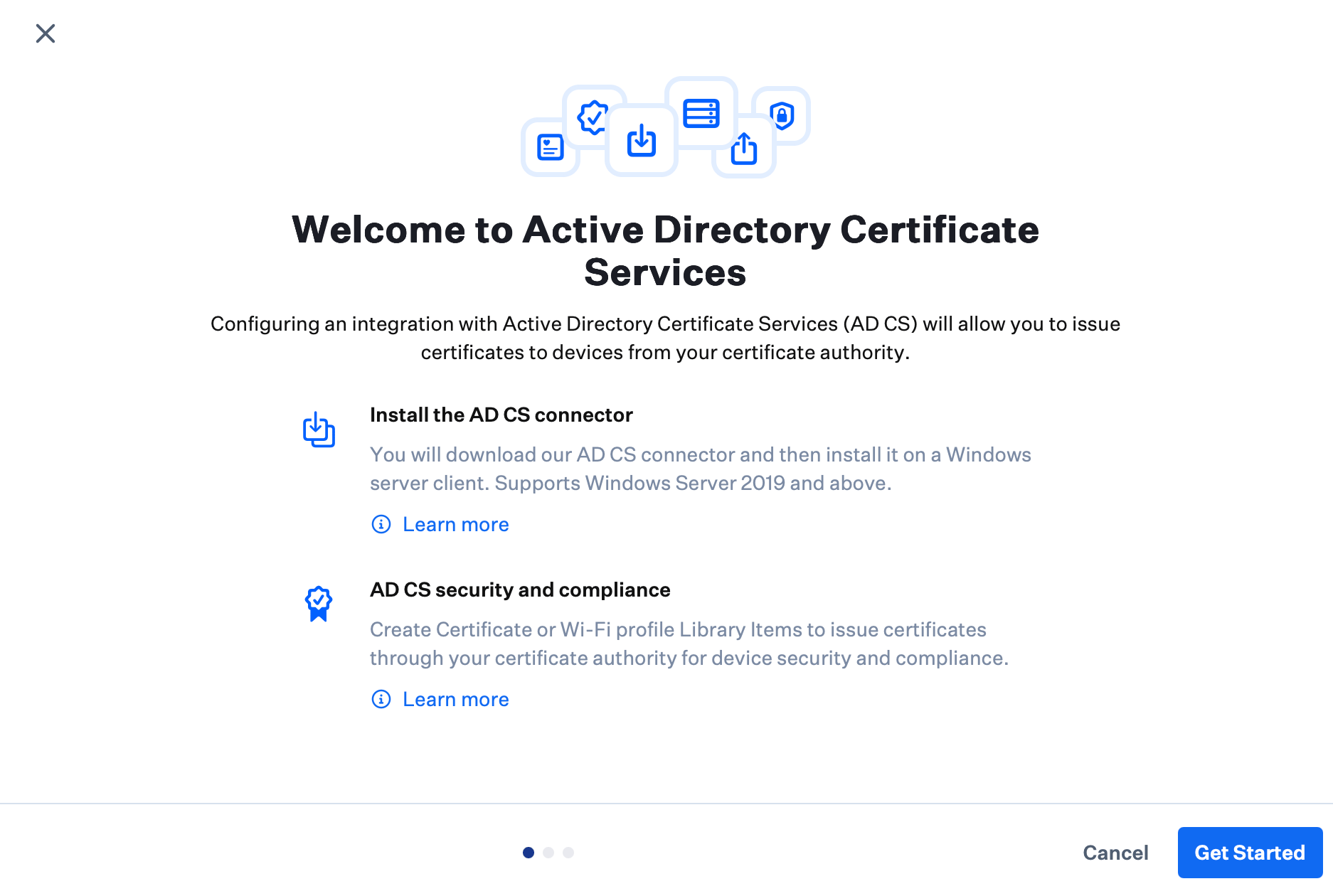
Start setup
Select Get started to continue setup.
5
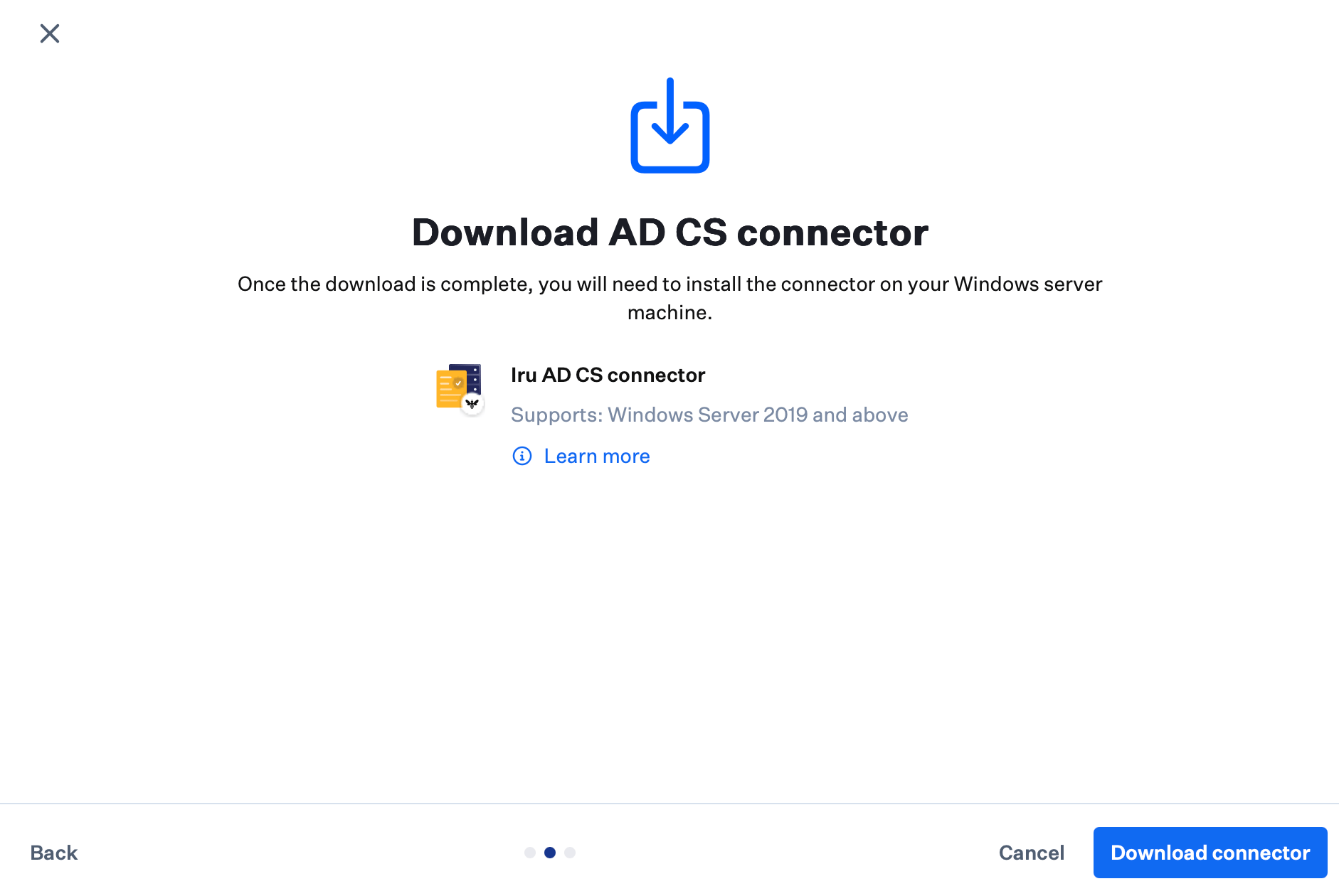
Download connector installer
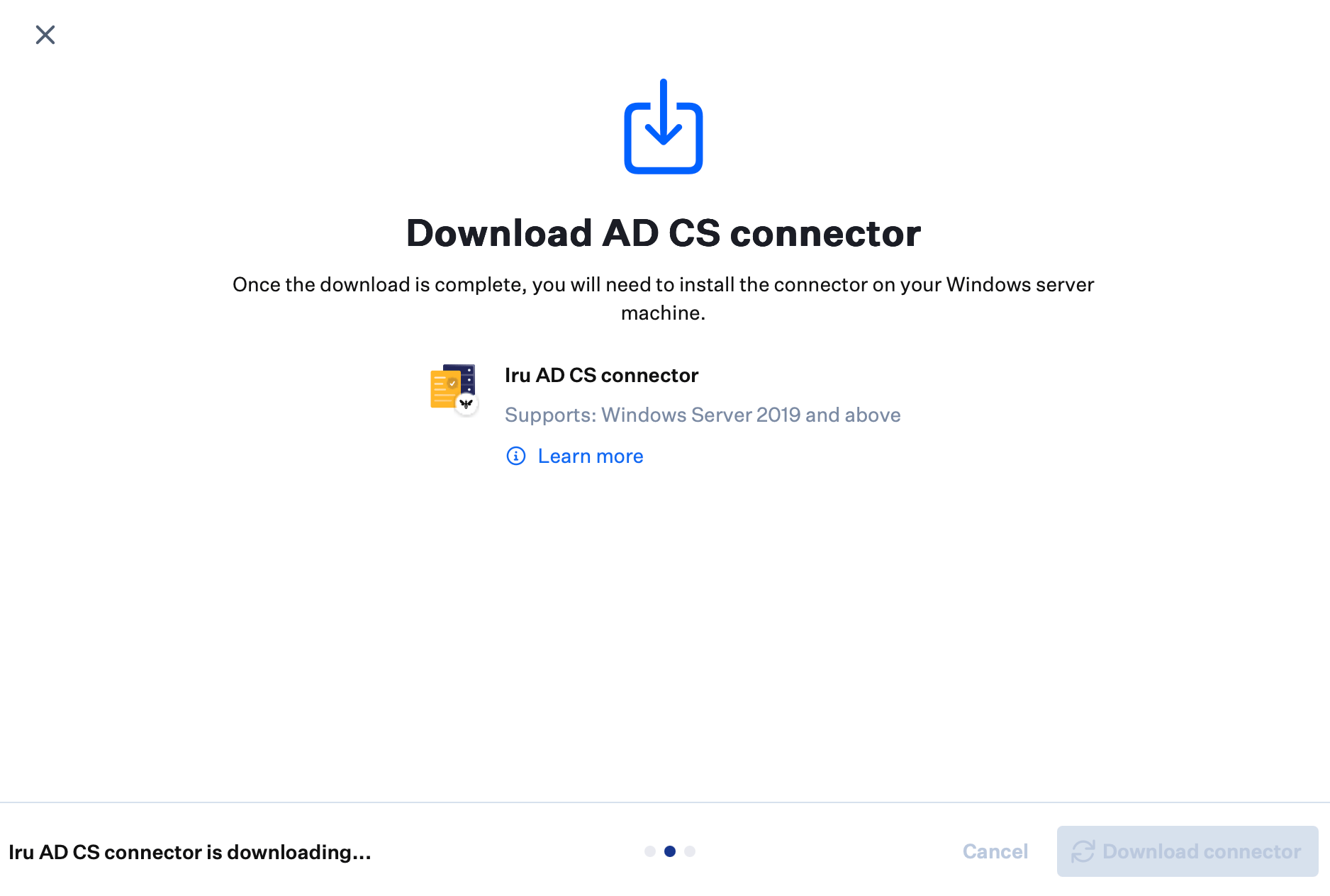
In the Download window, click Download connector.
6
Wait for download completion
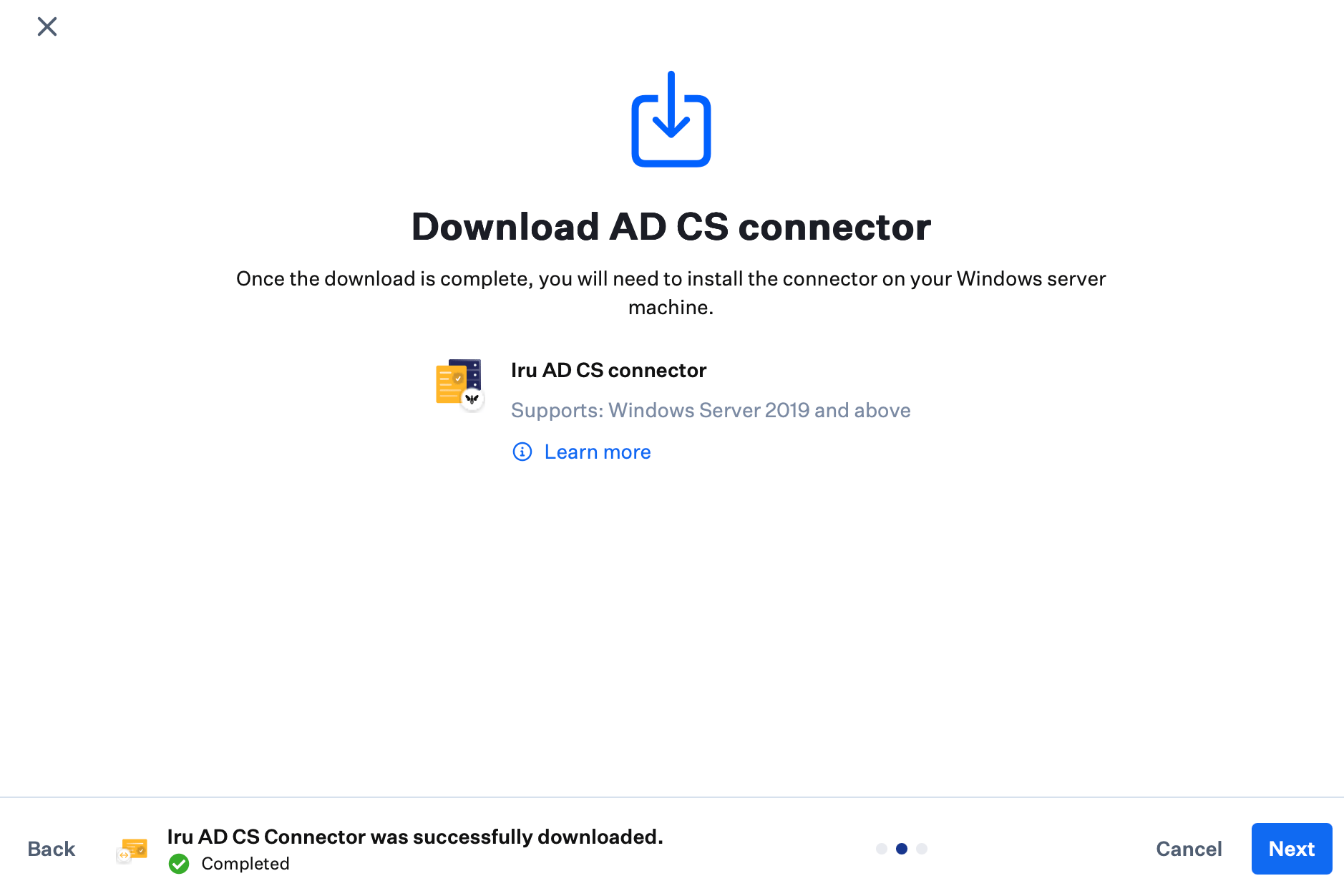
You should see an indicator displaying the download progress. Once the download is done, the Iru Endpoint AD CS Connector installer file will be in your default downloads folder.
7
Continue to the next setup step
Once the download completes, click Next.
8
Review connection pending instructions
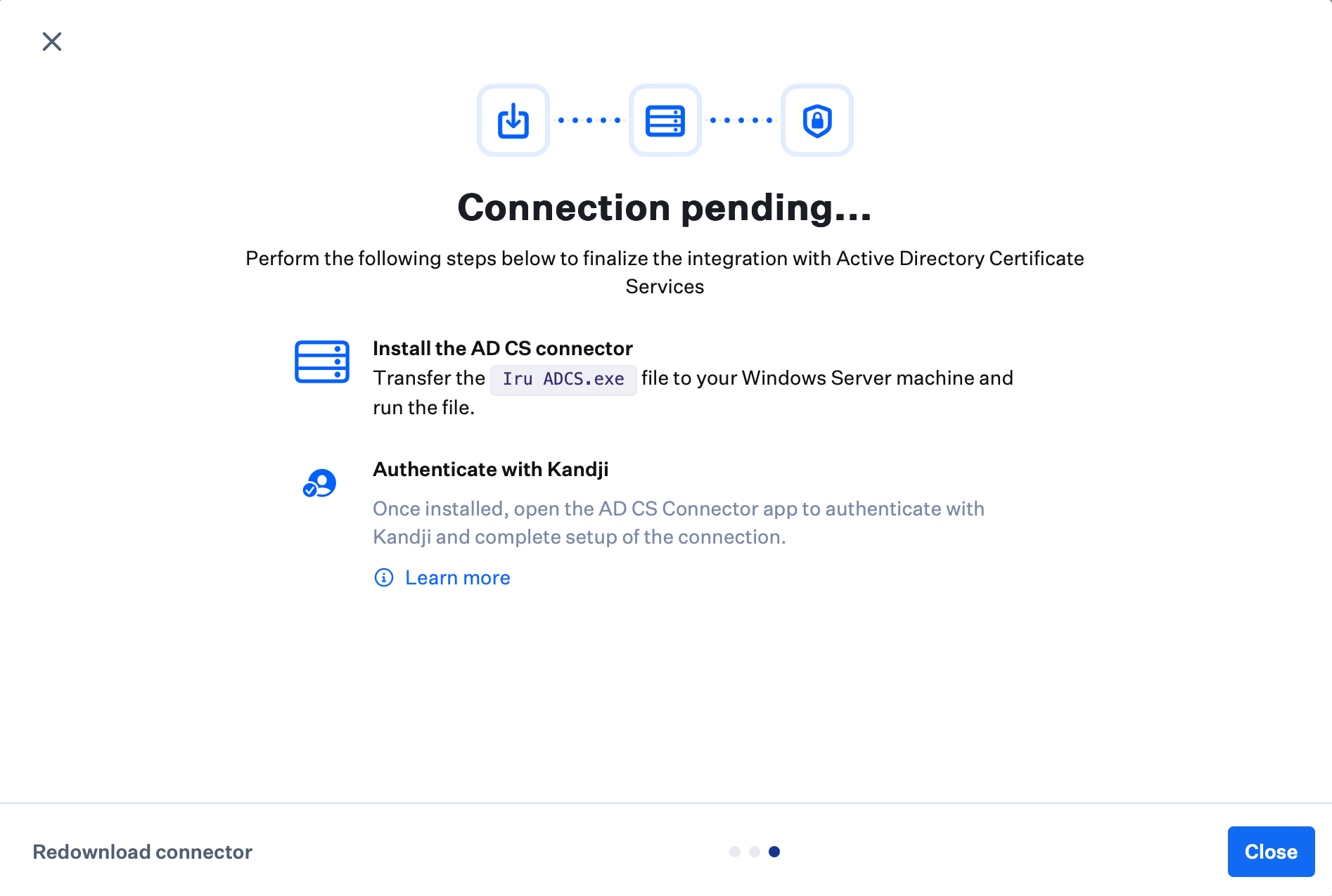
On the Connection pending… screen, read the tasks to perform on the Windows Server designated as the AD CS Connector.
9
Return to the Integrations page
To go back to the main Integrations page, click Close.
10
Locate AD CS integration card
An AD CS integration card should be visible on the main Integrations page.
11
Confirm pending installation status
The status will show as Pending installation… until the AD CS Connector has been installed on the Windows server, you have signed in with an Iru Endpoint administrator account, you have completed registration URL approval in the browser, and the Connector shows as active in Iru Endpoint.
12
Install the AD CS Connector on Windows Server
On the Windows Server designated as the AD CS Connector, follow AD CS Connector Installation to install and register the Connector, including sign-in and registration URL approval in the browser. When the Connector app shows Connected and the integration lists the Connector as Active, continue with the next section.
After you close the setup wizard with the installer downloaded:
1
Install and register the Connector on Windows Server
Complete AD CS Connector Installation, including initialization, registration URL approval, and verification that the Connector shows Connected and Active.
Use the Overview page to review Connector status and open actions such as install instructions, Redownload Connector, or delete a Connector row.
1
Open the AD CS integration overview
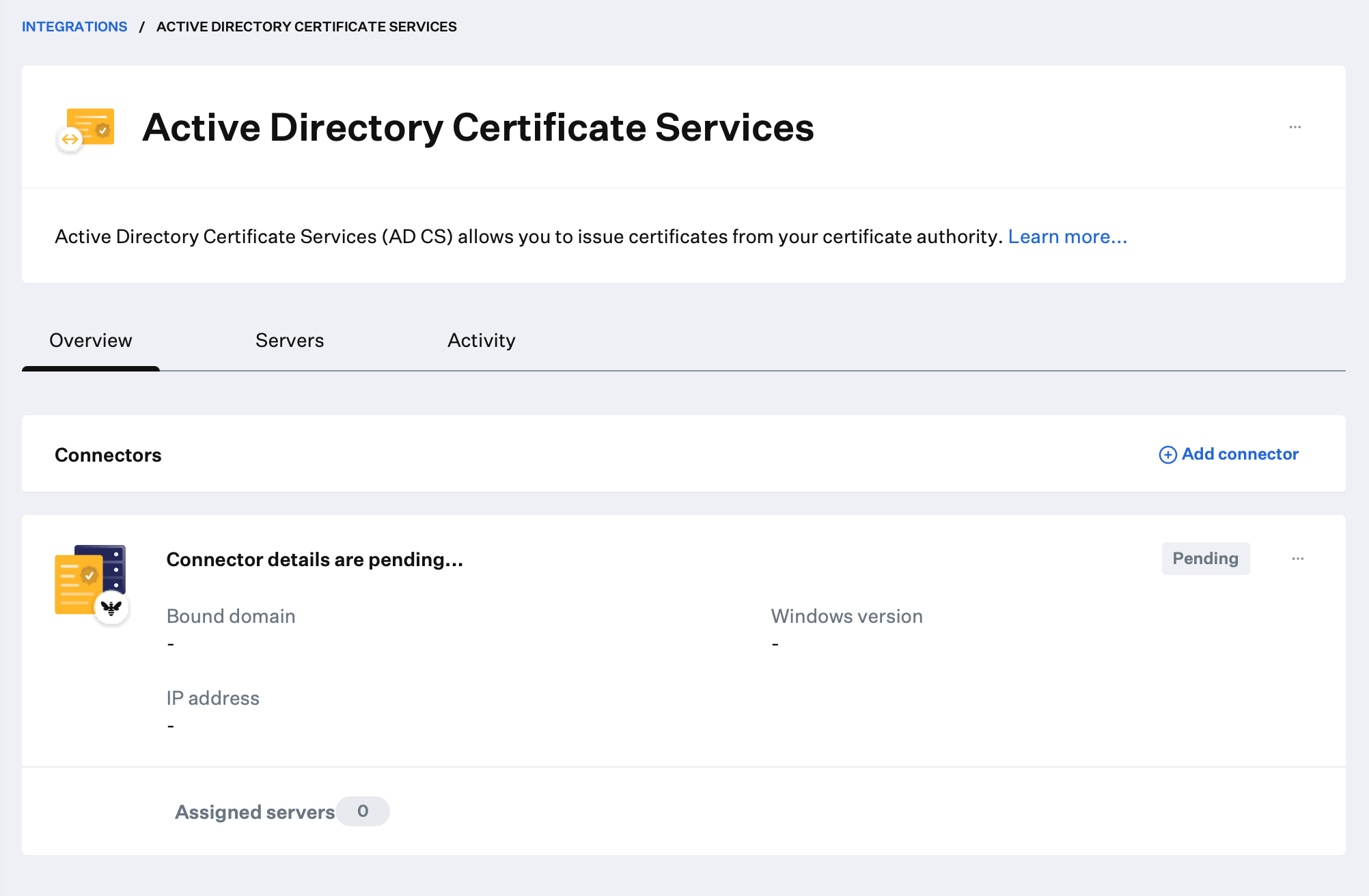
Click on the AD CS integration card to go to the Overview page.
2
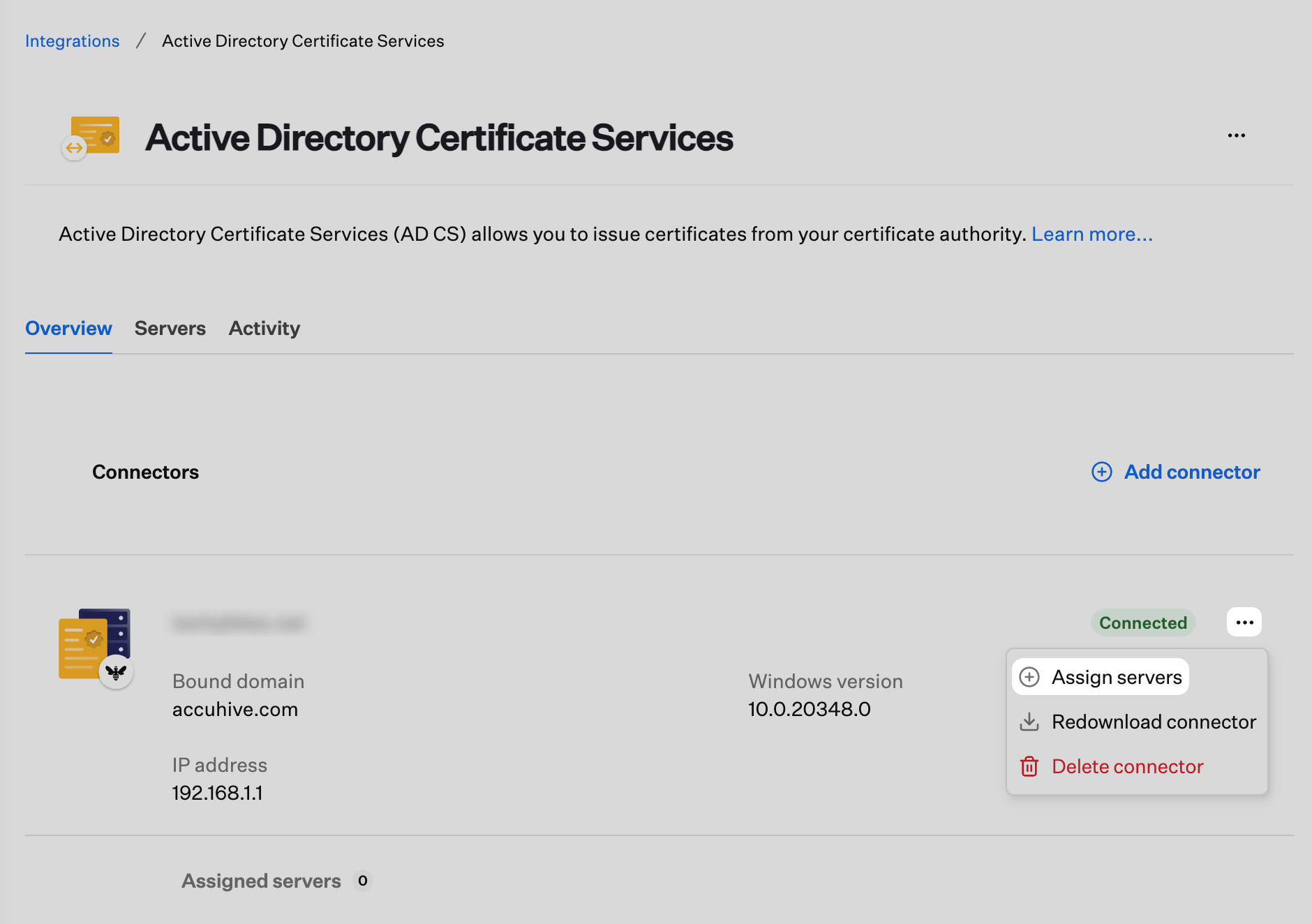
Review connector details
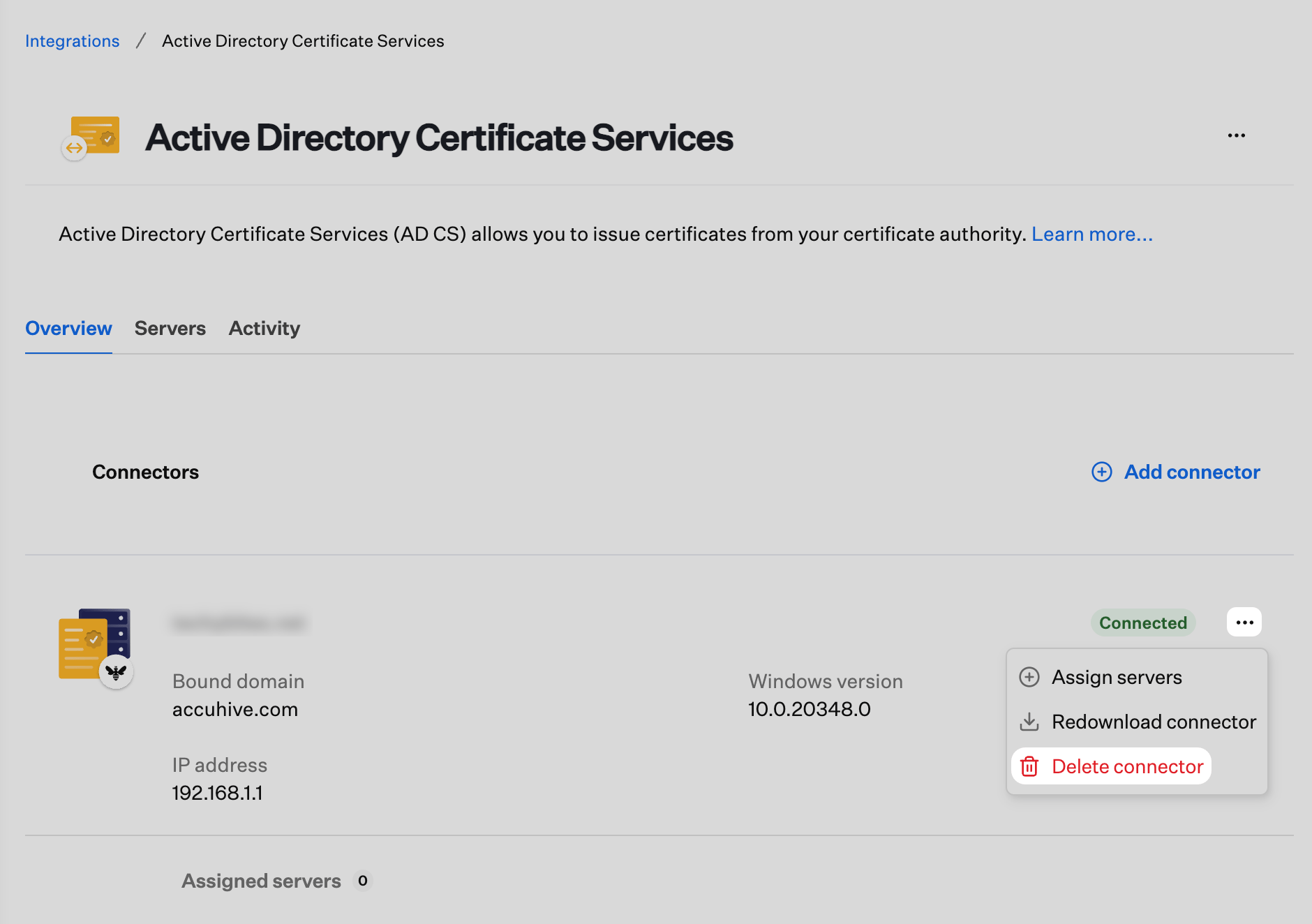
On the Overview page, you can see information about the AD CS Connector that was just added. Most of the details will not be populated until the AD CS Connector is installed on the Windows server and a connection is made back to Iru Endpoint.
The domain to which the AD CS Connector server is bound.
The Connector’s IP address.
Assigned AD CS servers. Servers can be assigned once the AD CS Connector is connected back to Iru Endpoint.
The version of the Windows server where the AD CS Connector is installed.
Status on the connection between Iru Endpoint and the Iru Endpoint AD CS Connector. The status will remain in a Pending state until the Connector is installed on the Windows server and a connection is made back to Iru Endpoint.
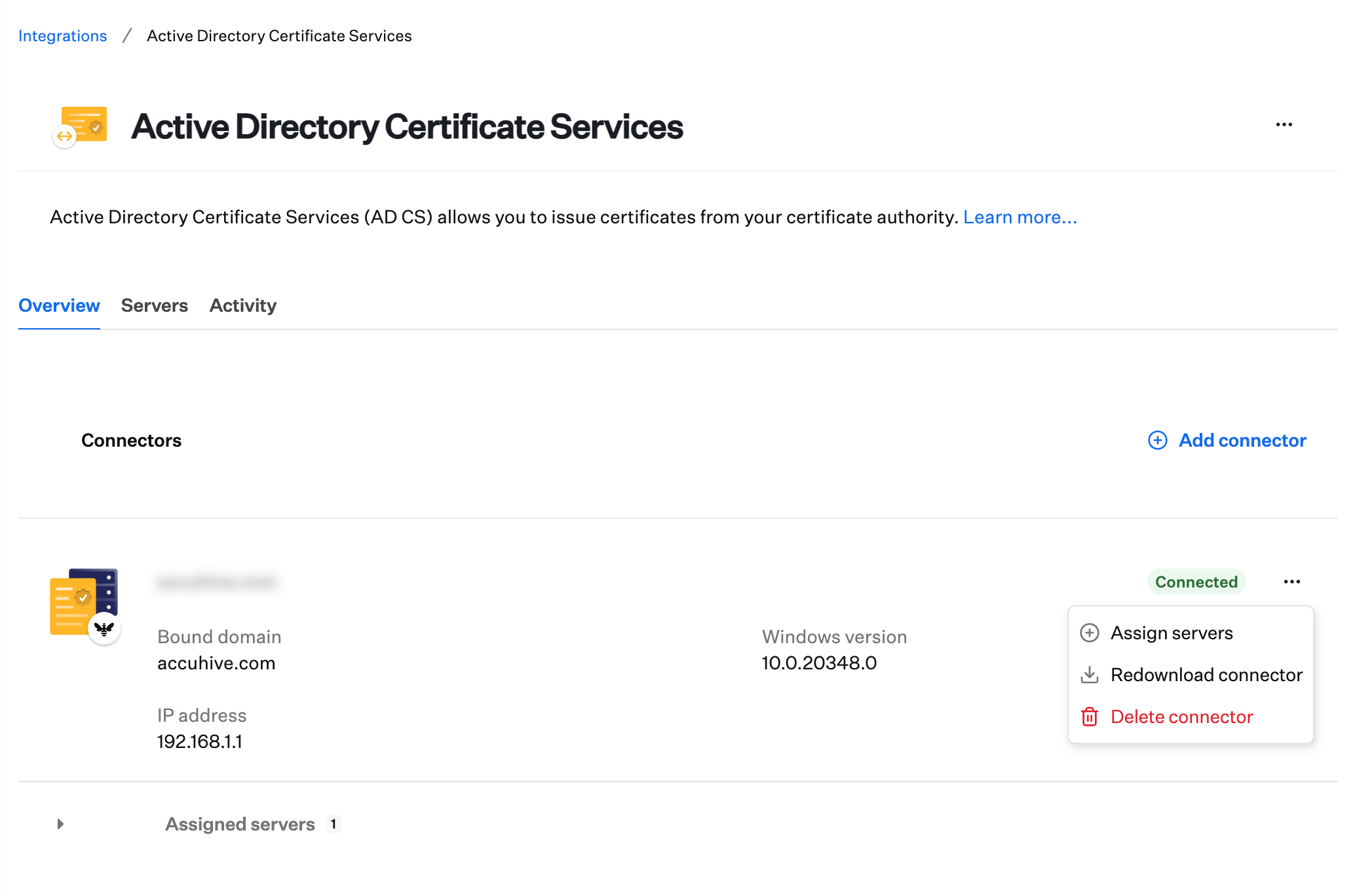
In the Connector action menu (…), you can view the installation instructions, redownload the connector installer, or delete the connector.
You must define the FQDN in the Server name field in the AD CS servers tray.
1
Open the Servers tab
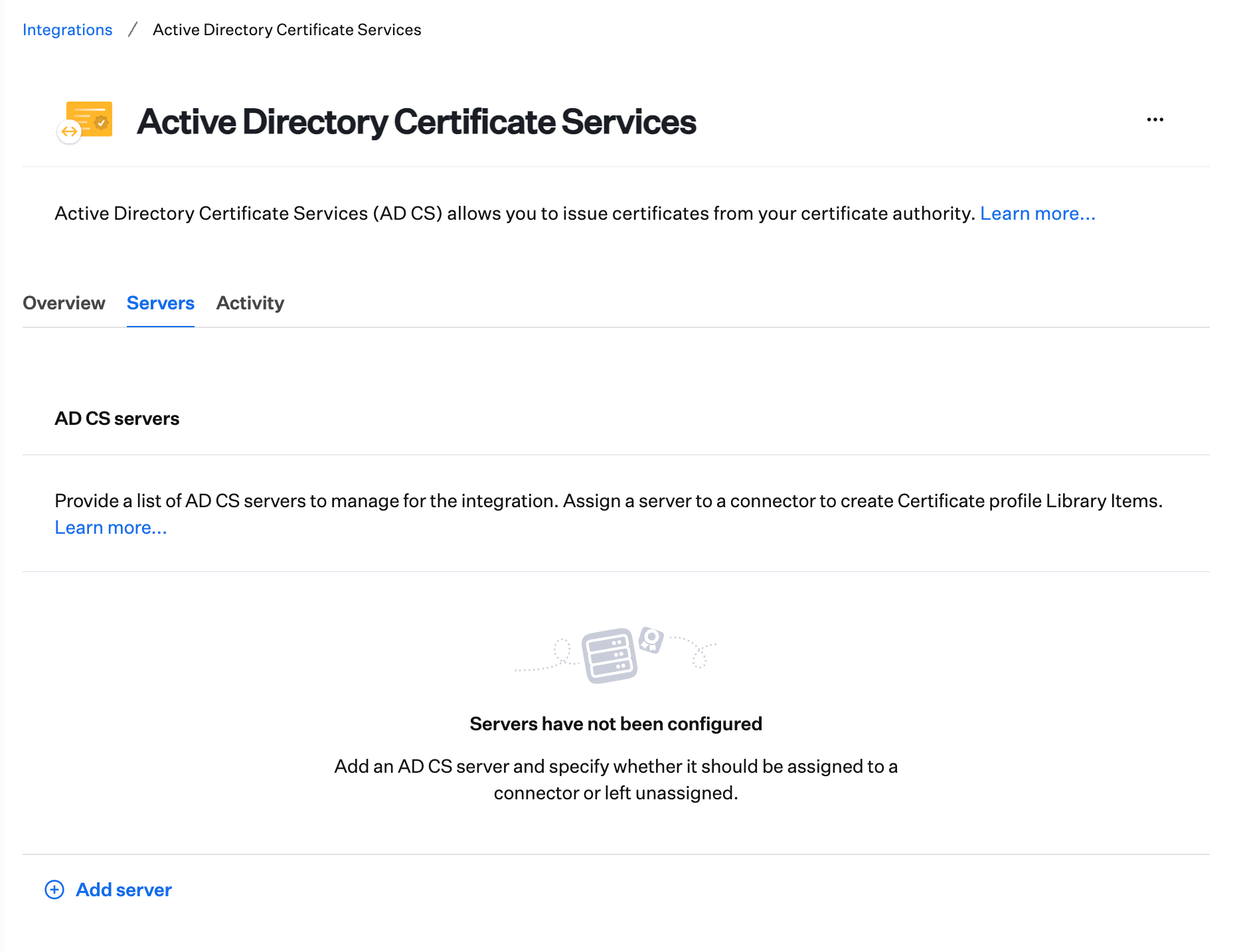
On the AD CS Integration page, click the Servers tab.
2
Click Add server
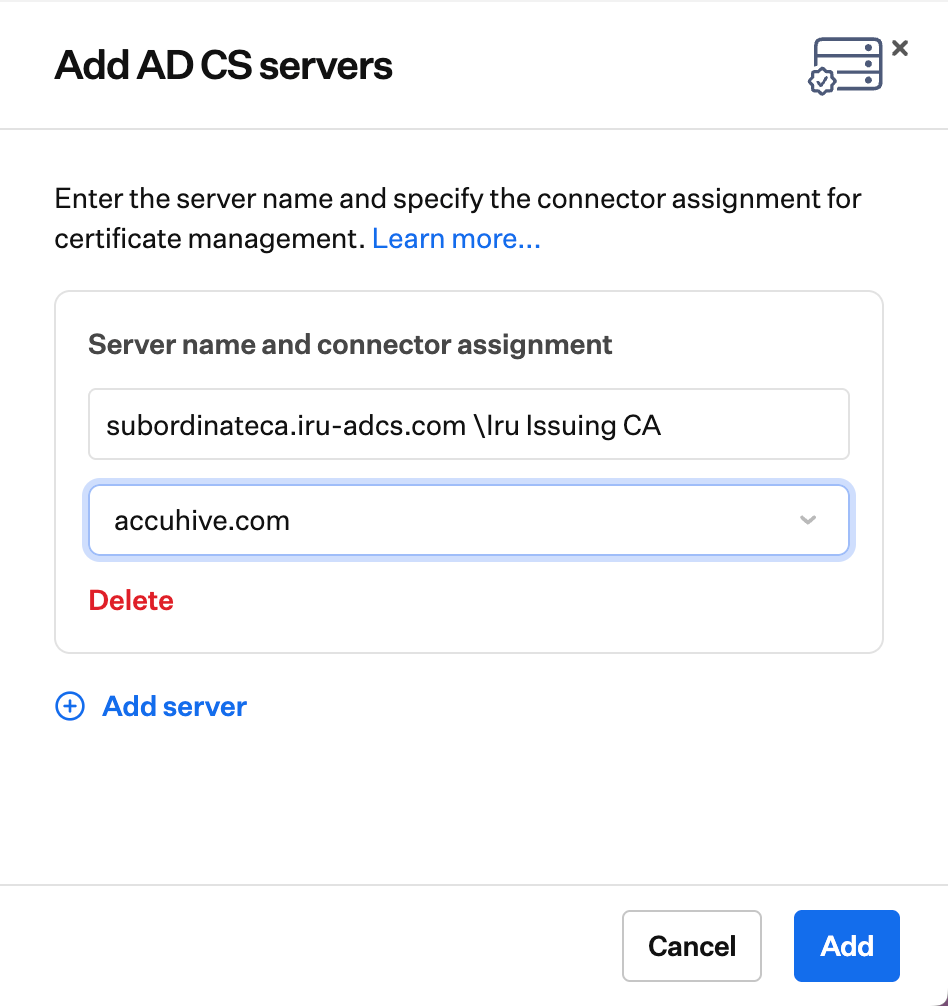
On the Servers tab, click + Add server to open the tray for adding an issuing CA.
3
Enter AD CS server details
In the tray, add the AD CS server(s) that will be used for creating certificates using the format of: ca_server_fqdn\issuing_ca_name (Example: subordinateca.example.com\QueenBee Issuing CA). The issuing_ca_name is found in the Certificate Authority Snap-in on the issuing CA Windows server. You will be able to assign the server once the Connector shows a status of Connected.
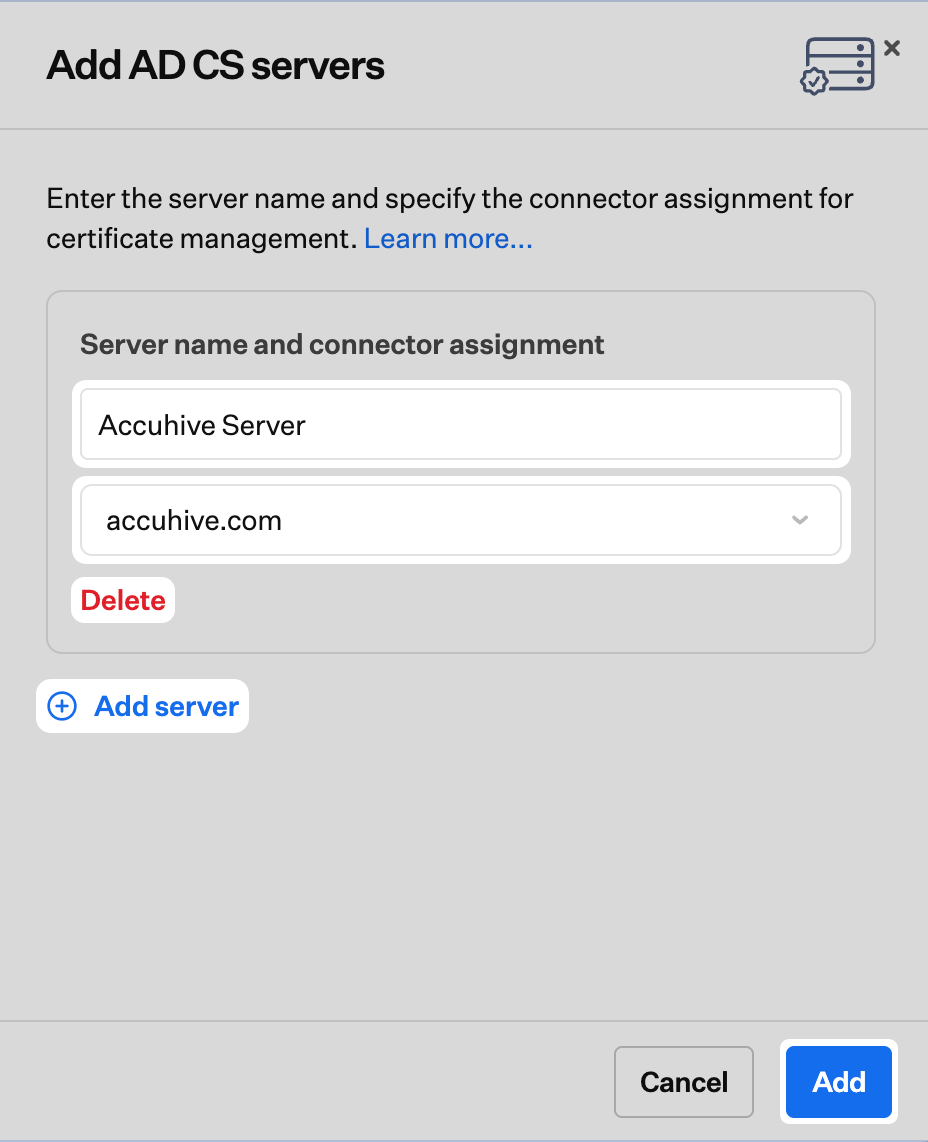
4
Add the server
Click Add.
5
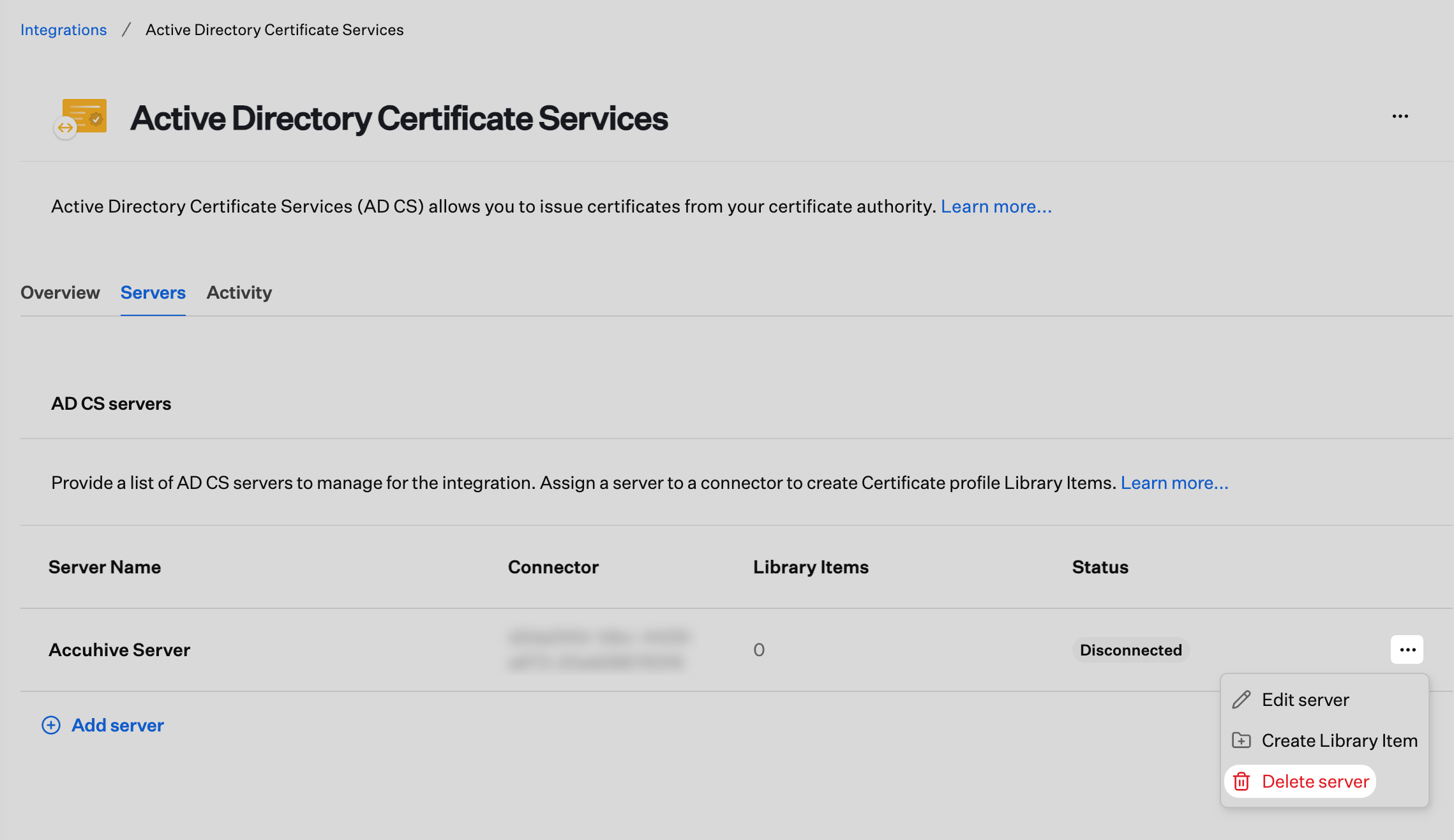
Review server status and management options
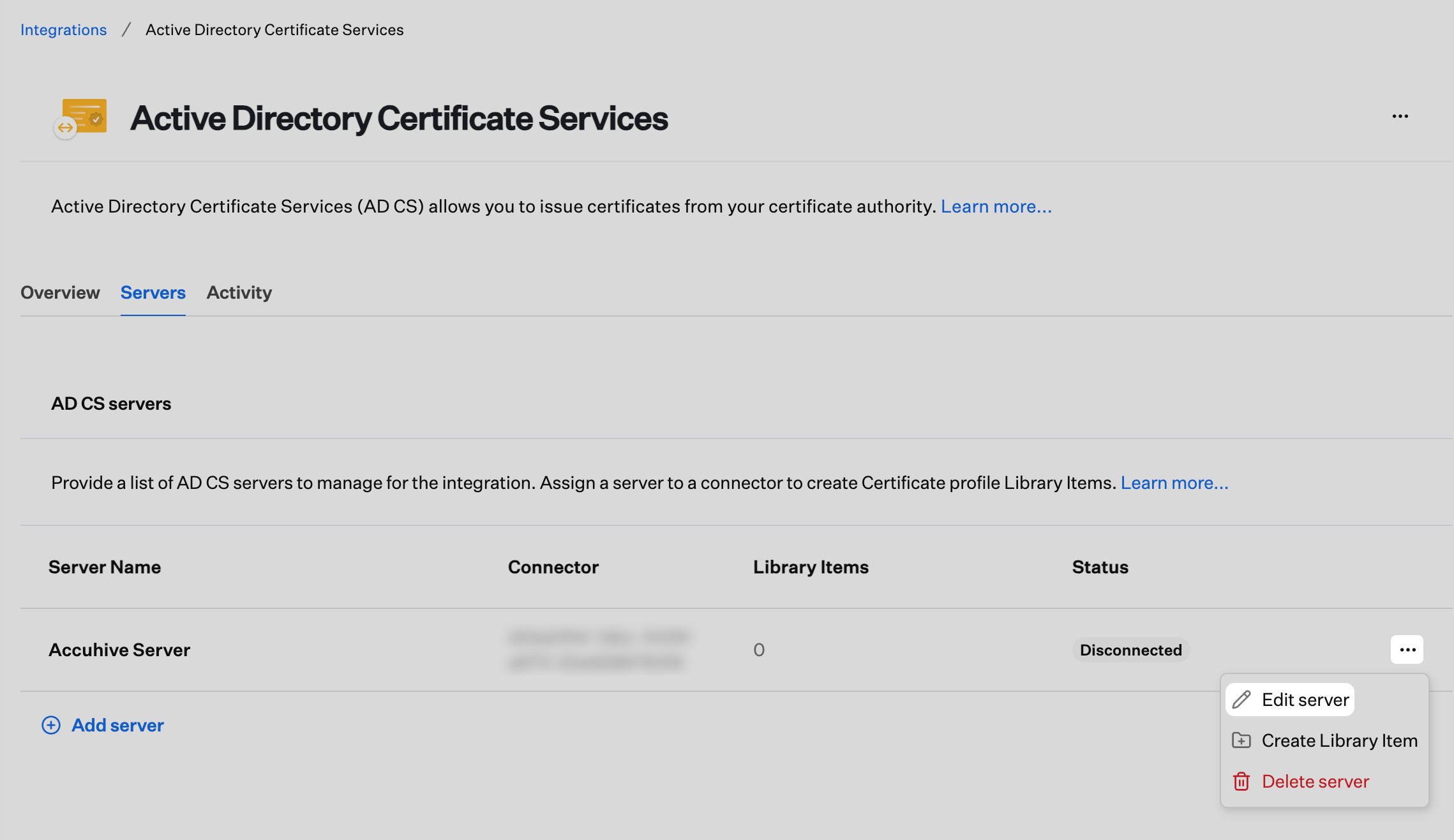
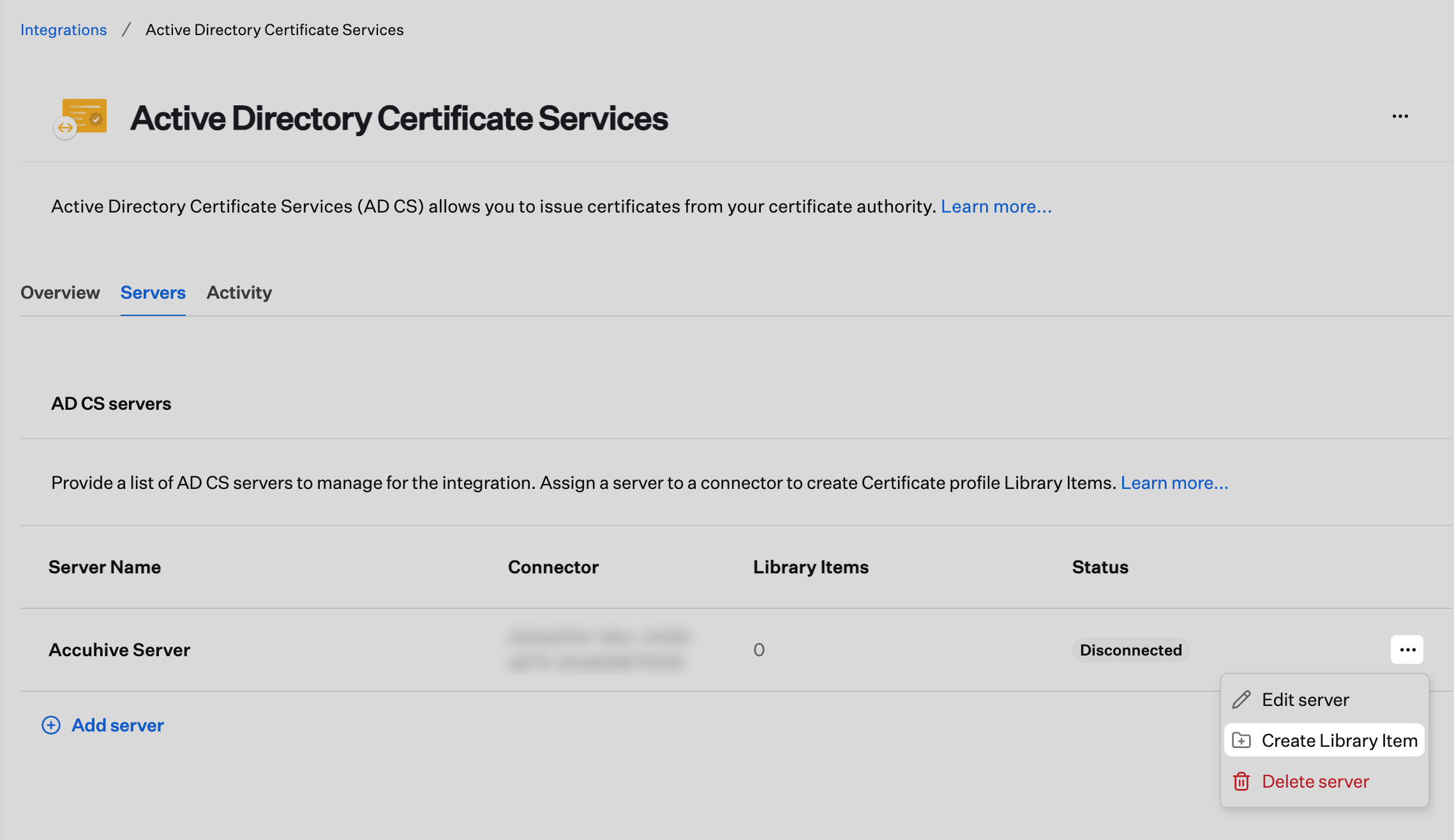
The status for the AD CS server will show as Disconnected until assigned to an AD CS Connector. Once the AD CS Connector status shows Connected, you can assign the AD CS CA server(s) to the AD CS Connector. You can edit or delete the AD CS server from the action menu (…) on the AD CS server card.
Once the AD CS Connector status shows as Connected, you can assign an AD CS server to the Connector.
1
Open connector actions
On the AD CS Integration Overview page, click the action menu (…) on the Connector card.
2
Select server assignment
Click Assign servers.
3
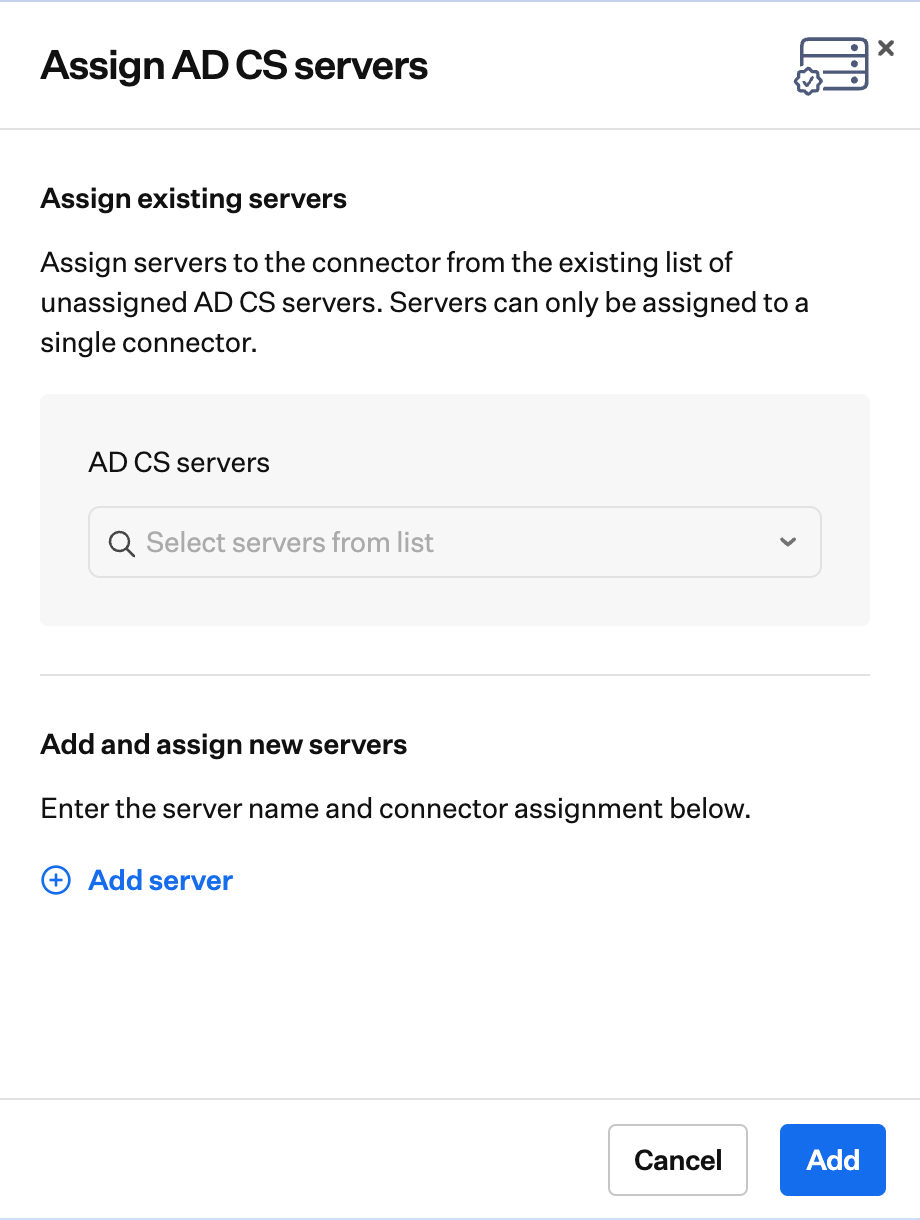
Choose AD CS servers
Select one or more AD CS servers from the list.
4
Add the assignment
Click Add.
There should now be at least one AD CS server assigned to the Connector.
When you replace the legacy Connector with the updated Connector on the same Windows Server, Iru Endpoint lists the updated registration as a new Connector. Use Assign servers on the new Connector card to attach your issuing CAs, then delete the legacy Connector entry from the action menu (…) on the legacy card. For the full Kandji-to-Iru workflow, see Migrating from Kandji to Iru with AD CS in AD CS Integration: Overview. For uninstall and install steps on the server, see Installation and Uninstalling the AD CS Connector in AD CS Connector Installation.
When the AD CS Servers tab lists at least one issuing CA, you can start a certificate-related Library Item from the server row instead of starting only from Library.
1
Open the server row menu
On the Servers tab, locate the AD CS server row, then open the action menu (…).
2
Start Create Library Item
Click Create Library Item.
3
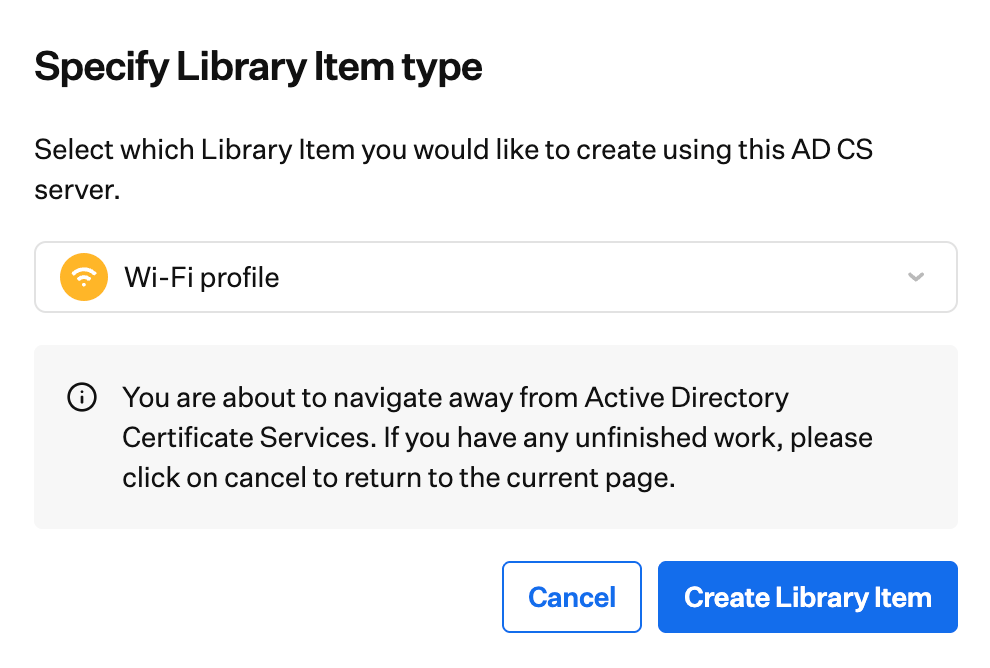
Choose the Library Item type
In Specify Library Item type, pick the profile type you want to create (for example Certificate or Wi-Fi), then continue. Iru Endpoint opens the usual Library Item editor for that type with AD CS fields available.
Removing a single Connector row is different from Removing the Integration below. Use this when you want to retire one Windows Server registration while keeping the AD CS integration enabled.
1
Open the AD CS Overview
In Integrations, open Active Directory Certificate Services, then open the Overview tab.
2
Delete the connector row
On the connector card you want to remove, open the action menu (…), then click Delete connector. This removes only that Connector registration in Iru Endpoint, not the entire AD CS integration.
3
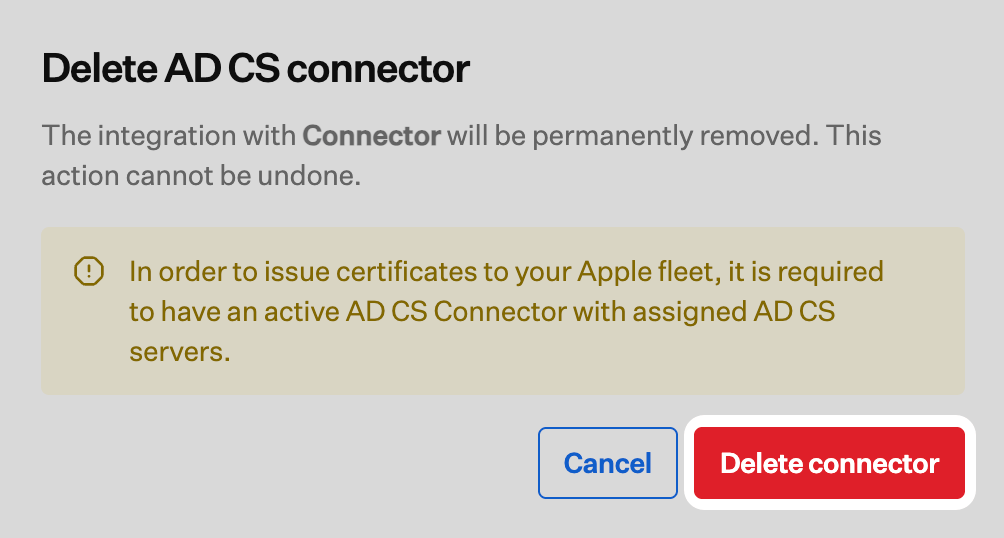
Confirm connector deletion
In the confirmation window, confirm removal of that connector from Iru Endpoint.
Deleting a connector row does not uninstall Iru Endpoint AD CS Connector from Windows Server. Remove the app on the host if you decommission that server. See Uninstalling the AD CS Connector.
This integration is a requirement to issue AD CS certificates to your fleet. Deleting this integration cannot be undone.
Use the steps below to delete the Active Directory Certificate Services integration from your Iru Endpoint tenant.
1
Open Integrations
In Iru Endpoint, navigate to Integrations.
2
Open the AD CS integration
Click on the Active Directory Certificate Services integration that you want to remove.
3
Select Delete integration
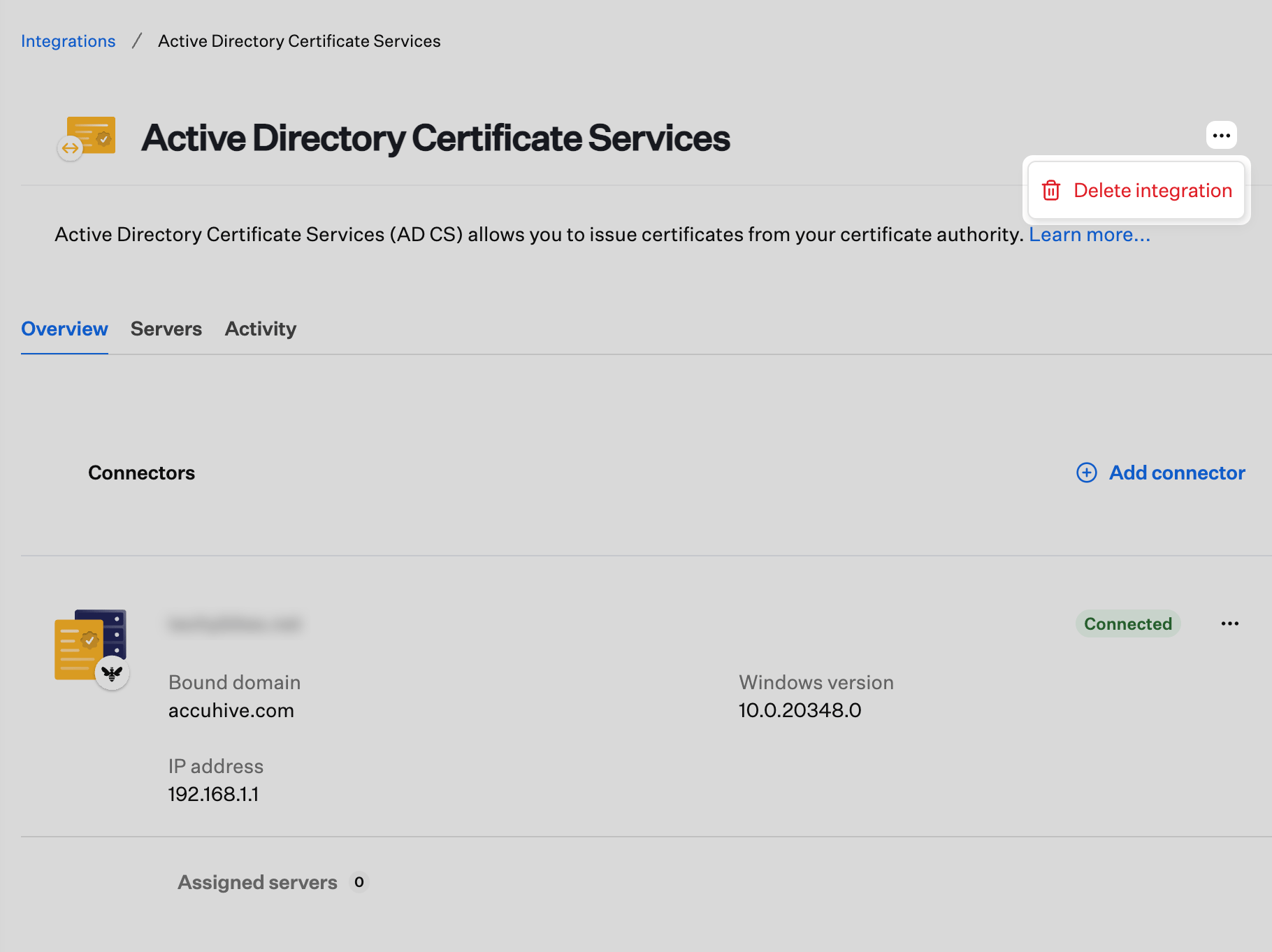
On the main Active Directory Certificate Services page, click the Action menu (…) and click Delete integration.
4
Confirm deletion
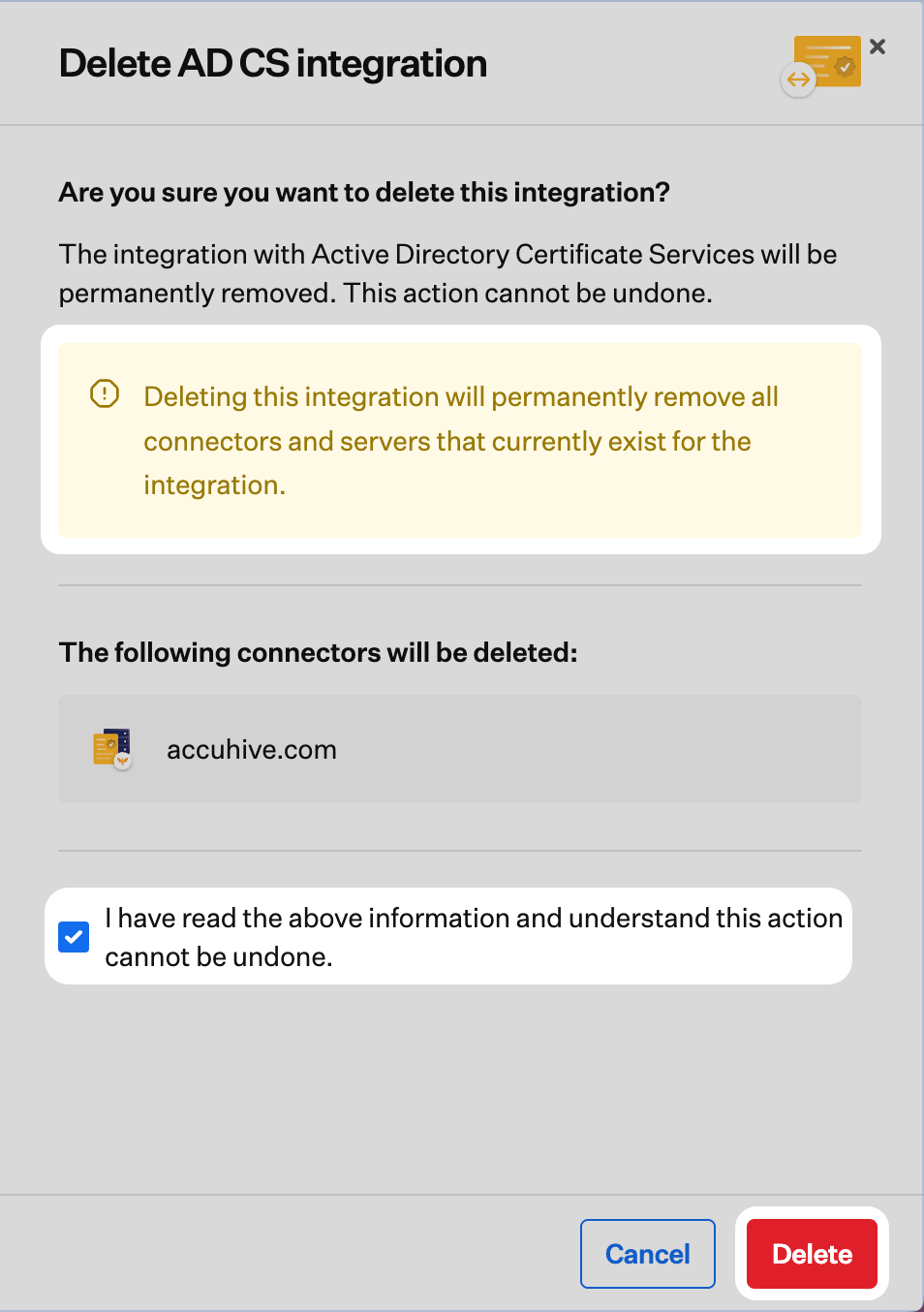
In the Delete AD CS Integration window, check the box to confirm that you’ve read the warning, then click the Delete button. Once the integration is removed, you will be taken back to the main Integration page.
Removing the integration in Iru Endpoint does not uninstall Iru Endpoint AD CS Connector from your Windows Server; the app remains on the host until you remove it there. On each Connector server, open Settings > Apps > Apps & features, select Iru Endpoint AD CS Connector, then choose Uninstall. For other uninstall paths (for example Control Panel on older Windows Server versions), see Uninstalling the AD CS Connector.