> ## Documentation Index
> Fetch the complete documentation index at: https://docs.iru.com/llms.txt
> Use this file to discover all available pages before exploring further.
# Connect BambooHR
> Connect BambooHR to Iru Identity so it reads the standard employee directory and keeps your Iru directory in sync as workers join, change, or leave.
Connecting **BambooHR** lets Iru pull employee records straight from BambooHR and
keep your [directory](/en/identity/directory/directory-overview) in sync. When
someone is hired, changes roles, or leaves, those updates flow into Iru on their
own.
BambooHR setup is quick: **connect**, then **map your fields**. There's no report to
configure. Iru reads directly from BambooHR's standard employee directory.
For the BambooHR-specific steps only. For concepts shared across all sync
connections (the unique identifier, required fields, IQL, and what happens on
each sync), see
[Directory Sync](/en/identity/directory/directory-sync).
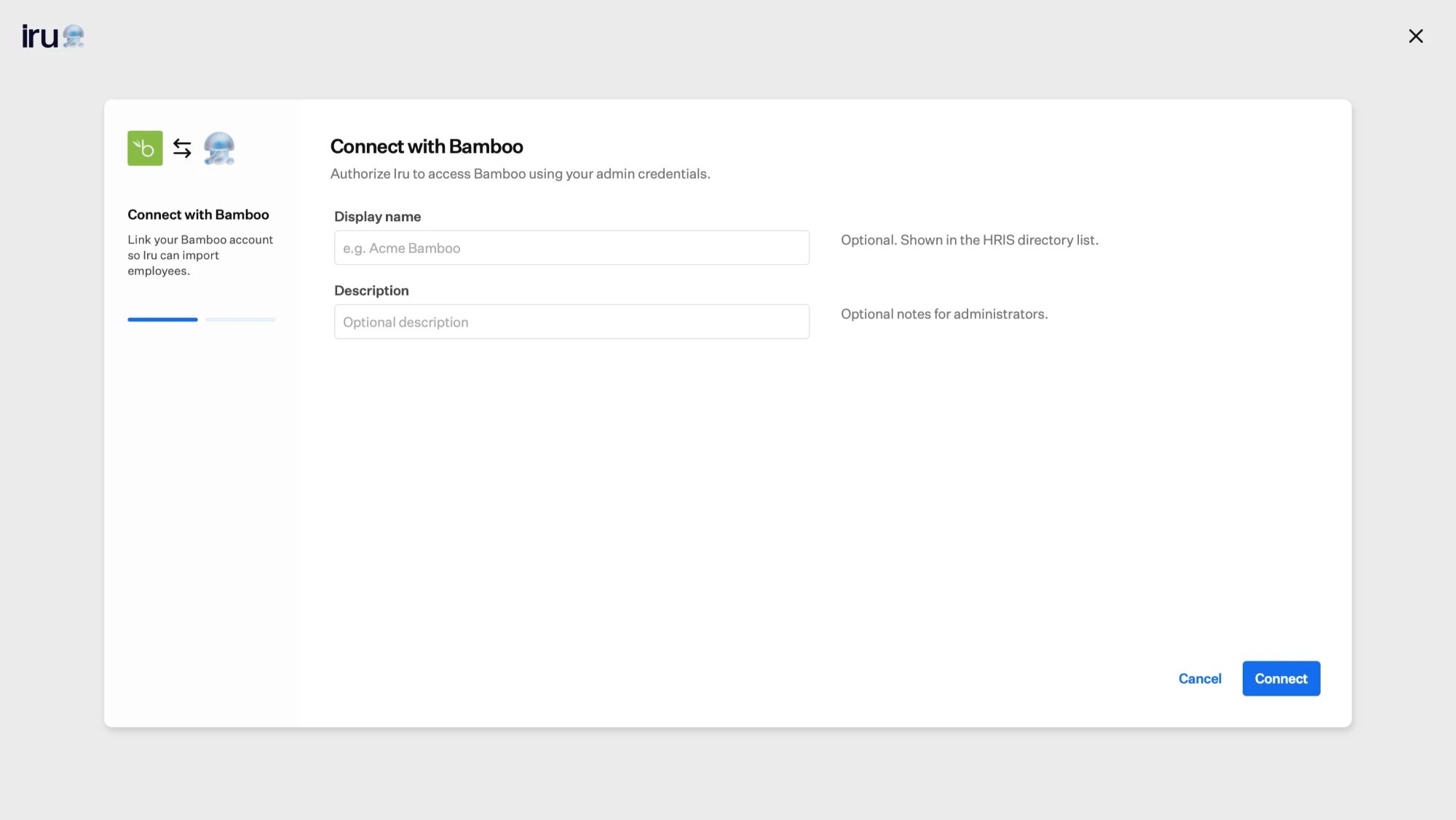
In **Directory → Sync**, select **Connect Source** and pick **BambooHR**.
Give the connection a **name** and an optional **description**, then **Connect**. A
BambooHR window opens where you authorize access with your BambooHR administrator
credentials. Once BambooHR confirms the connection, the window closes and Iru
continues.
 Use a dedicated admin / integration account where you can, so the connection
keeps working regardless of any one user's status.
BambooHR has a **standard set of employee fields** (first and last name, work and
home email, phone numbers, job title, department, supervisor, hire date, address,
and employee ID), so Iru already knows what's available and lays them out for you to
match. There's nothing to build on the BambooHR side first.
* **Set a unique identifier**, typically the BambooHR **employee ID**. Once you
save the connection, it can't be changed.
* **Map the required attributes:** **email, first name, last name, and username**
must be mapped; everything else is optional.
* **Transform with IQL when needed:** pick a field, or write a short IQL
expression. Iru suggests the available BambooHR fields and checks the expression
as you type.
Examples with BambooHR fields:
* Build a username from the work email: `workEmail.split("@")[0]`
* Combine first and last name: `firstName + " " + lastName`
* Prefer work email, fall back to home email: `optional.ofNonZeroValue(workEmail).orValue(homeEmail)`
See [Map your data](/en/identity/directory/directory-sync#map-your-data) for more
on mapping, including the safe pattern for sometimes-blank fields.
Save your mappings. You'll land on the connection's detail page. Review
everything, then **Enable**. A connection starts **disabled**, so enabling it kicks
off the first import and keeps Iru in sync.
On the detail page you can later **re-authenticate**, **edit your mappings**, and
**review activity, effective users, and sync errors**.
**Coming from Workday?** BambooHR is a little simpler: Workday has an extra step
where you point Iru at a custom report, while BambooHR reads its standard employee
directory, so you go straight from connecting to mapping. Everything else (the
unique identifier, required fields, and IQL) works the same way.
## Related
The shared concepts behind every Directory Sync provider.
The other supported HR system. Includes a report step.
Use a dedicated admin / integration account where you can, so the connection
keeps working regardless of any one user's status.
BambooHR has a **standard set of employee fields** (first and last name, work and
home email, phone numbers, job title, department, supervisor, hire date, address,
and employee ID), so Iru already knows what's available and lays them out for you to
match. There's nothing to build on the BambooHR side first.
* **Set a unique identifier**, typically the BambooHR **employee ID**. Once you
save the connection, it can't be changed.
* **Map the required attributes:** **email, first name, last name, and username**
must be mapped; everything else is optional.
* **Transform with IQL when needed:** pick a field, or write a short IQL
expression. Iru suggests the available BambooHR fields and checks the expression
as you type.
Examples with BambooHR fields:
* Build a username from the work email: `workEmail.split("@")[0]`
* Combine first and last name: `firstName + " " + lastName`
* Prefer work email, fall back to home email: `optional.ofNonZeroValue(workEmail).orValue(homeEmail)`
See [Map your data](/en/identity/directory/directory-sync#map-your-data) for more
on mapping, including the safe pattern for sometimes-blank fields.
Save your mappings. You'll land on the connection's detail page. Review
everything, then **Enable**. A connection starts **disabled**, so enabling it kicks
off the first import and keeps Iru in sync.
On the detail page you can later **re-authenticate**, **edit your mappings**, and
**review activity, effective users, and sync errors**.
**Coming from Workday?** BambooHR is a little simpler: Workday has an extra step
where you point Iru at a custom report, while BambooHR reads its standard employee
directory, so you go straight from connecting to mapping. Everything else (the
unique identifier, required fields, and IQL) works the same way.
## Related
The shared concepts behind every Directory Sync provider.
The other supported HR system. Includes a report step.