> ## Documentation Index
> Fetch the complete documentation index at: https://docs.iru.com/llms.txt
> Use this file to discover all available pages before exploring further.
# Snowflake
> Connect Snowflake to Iru Compliance with key-pair JWT authentication and ACCOUNT_USAGE access to collect role grants, users, and data-governance evidence.
### About Snowflake
Iru collects **warehouse and account usage**, **database/schema metadata**, **roles and grants**, and **login/query history** from Snowflake, primarily via **`SNOWFLAKE.ACCOUNT_USAGE`** views. Authentication uses **key-pair authentication**: short-lived **JWTs** signed with your **RSA private key**, verified against the **public key** registered on the Snowflake **user** Iru uses.
### How It Works
```http lines theme={null}
Authorization: Bearer YOUR_SIGNED_JWT
X-Snowflake-Authorization-Token-Type: KEYPAIR_JWT
```
JWTs are **short-lived** (about **60 seconds**); Iru regenerates them using the configured key and account details.
| Detail | Value |
| ------------------ | ------------- |
| **Category** | Data platform |
| **Authentication** | Key-pair JWT |
Official references: [Key-pair authentication](https://docs.snowflake.com/en/user-guide/key-pair-auth), [Account identifiers](https://docs.snowflake.com/en/user-guide/admin-account-identifier), [REST API](https://docs.snowflake.com/en/developer-guide/snowflake-rest-api/snowflake-rest-api), [ACCOUNT\_USAGE](https://docs.snowflake.com/en/sql-reference/account-usage).
### Prerequisites
* **`SECURITYADMIN`** (or equivalent) to assign **`RSA_PUBLIC_KEY`** on a dedicated service user.
* **OpenSSL** (or another tool) to generate a **2048-bit** (or larger) RSA key pair.
* Your **account identifier** (`orgname-accountname` preferred, or legacy locator with region/cloud if required).
### Connect Snowflake to Iru
Complete this tab before you connect the source in Compliance.
Sign in to Snowsight or the classic console with **`SECURITYADMIN`** (or equivalent) so you can run **`ALTER USER`** and **`GRANT`** statements for the integration user.
Use a trusted machine with **OpenSSL** (or another RSA tool your security team approves). You will keep **`snowflake_private_key.pem`** only in your vault. Never commit it to git or send it to Snowflake support.
Example with OpenSSL:
```bash lines theme={null}
openssl genrsa -out snowflake_private_key.pem 2048
openssl rsa -in snowflake_private_key.pem -pubout -out snowflake_public_key.pem
```
Protect **`snowflake_private_key.pem`**. Never commit it or share it with Snowflake.
As an administrator, strip the PEM headers and newlines from **`snowflake_public_key.pem`** so only the base64 body remains, then run:
```sql theme={null}
ALTER USER YOUR_USERNAME SET RSA_PUBLIC_KEY='YOUR_PUBLIC_KEY';
```
Snowflake allows **two** keys per user (`RSA_PUBLIC_KEY` / `RSA_PUBLIC_KEY_2`) for rotation. Assign the new key to **`RSA_PUBLIC_KEY_2`**, update Iru, then drop the old key.
Use **Snowflake CLI** or a library. For example:
```bash lines theme={null}
snow connection generate-jwt \
--account YOUR_ACCOUNT_IDENTIFIER \
--user YOUR_USERNAME \
--private-key-path snowflake_private_key.pem
```
Copy the JWT string for the initial Iru handshake; ongoing regeneration is handled in product.
The integration user needs a role that can read **`SNOWFLAKE`** shared metadata, for example:
```sql lines theme={null}
GRANT IMPORTED PRIVILEGES ON DATABASE SNOWFLAKE TO ROLE YOUR_ROLE;
GRANT ROLE YOUR_ROLE TO USER YOUR_USERNAME;
```
Continue on the [**Iru Compliance**](#iru-compliance) tab.
Finish the [**Snowflake**](#snowflake) tab first.
In Iru Compliance, on the left navigation bar, expand **Compliance** and select **Sources**.
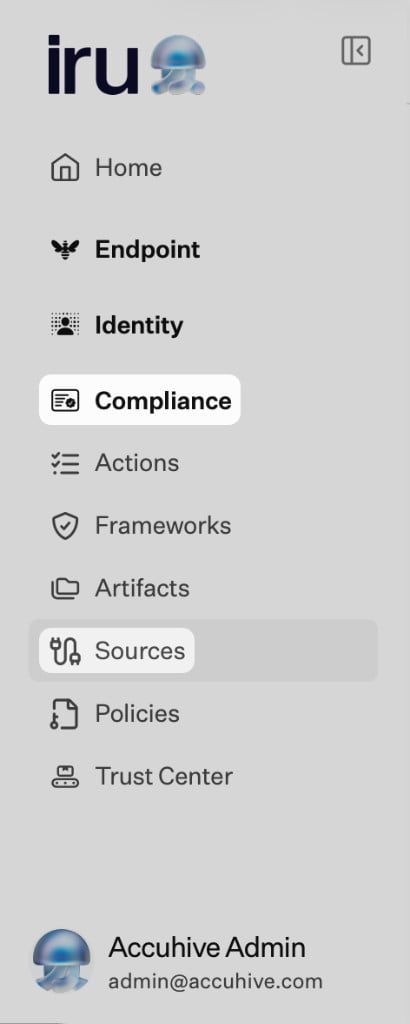 Find **Snowflake** (use **Category** or **Search by name or description**). On that card, turn on the **toggle**. A browser tab or window may open for the connector wizard.
Choose the host pattern that matches your account:
* Standard: `https://YOUR_ACCOUNT_IDENTIFIER.snowflakecomputing.com`
* **PrivateLink**: `https://YOUR_ACCOUNT_IDENTIFIER.privatelink.snowflakecomputing.com`
Enter **`account_identifier`** and confirm server variables before continuing.
When prompted, paste the **JWT**.
Click **Submit Bearer Token**. When the connection succeeds, the wizard shows **Connection Configured**.
Close the **Iru is requesting access to external services** browser tab, then return to **Compliance** → **Sources** and confirm the **Snowflake** card is **Active**.
### Troubleshooting
Check **pop-up blocker** settings for the Iru site and try again.
Wizard session expired. Toggle the source off and on, then retry.
Run **`DESCRIBE USER`** to confirm the fingerprint matches and the private key pairs with the registered public key.
Prefer **`org-account`** form; legacy locators may need **region/cloud** suffix.
Ensure Iru egress can reach your endpoint; allowlist if required.
**`IMPORTED PRIVILEGES`** on **`SNOWFLAKE`** for the Iru role.
### Considerations
Iru does **not** run arbitrary queries against your tables. It reads governance-oriented metadata and usage views.
### Related Articles
Browse and manage every Compliance source.
Frameworks, actions, and **Artifacts**.
How Endpoint, Compliance, and Identity fit together.
Upload, review, and organize evidence from sources and actions.
Find **Snowflake** (use **Category** or **Search by name or description**). On that card, turn on the **toggle**. A browser tab or window may open for the connector wizard.
Choose the host pattern that matches your account:
* Standard: `https://YOUR_ACCOUNT_IDENTIFIER.snowflakecomputing.com`
* **PrivateLink**: `https://YOUR_ACCOUNT_IDENTIFIER.privatelink.snowflakecomputing.com`
Enter **`account_identifier`** and confirm server variables before continuing.
When prompted, paste the **JWT**.
Click **Submit Bearer Token**. When the connection succeeds, the wizard shows **Connection Configured**.
Close the **Iru is requesting access to external services** browser tab, then return to **Compliance** → **Sources** and confirm the **Snowflake** card is **Active**.
### Troubleshooting
Check **pop-up blocker** settings for the Iru site and try again.
Wizard session expired. Toggle the source off and on, then retry.
Run **`DESCRIBE USER`** to confirm the fingerprint matches and the private key pairs with the registered public key.
Prefer **`org-account`** form; legacy locators may need **region/cloud** suffix.
Ensure Iru egress can reach your endpoint; allowlist if required.
**`IMPORTED PRIVILEGES`** on **`SNOWFLAKE`** for the Iru role.
### Considerations
Iru does **not** run arbitrary queries against your tables. It reads governance-oriented metadata and usage views.
### Related Articles
Browse and manage every Compliance source.
Frameworks, actions, and **Artifacts**.
How Endpoint, Compliance, and Identity fit together.
Upload, review, and organize evidence from sources and actions.