> ## Documentation Index
> Fetch the complete documentation index at: https://docs.iru.com/llms.txt
> Use this file to discover all available pages before exploring further.
# Klaviyo
> Connect Klaviyo to Iru Compliance with a scoped read-only private API key to collect account user access, API key inventory with scopes, and list and segment metadata.
### About Klaviyo
Iru reads **account users and their permissions**, **API keys with their scopes**, **list and segment metadata**, and **integration connections** from Klaviyo's API. Authentication uses a **private API key** created under **Settings** → **API keys**. Klaviyo private keys are **scoped at creation**. Grant read-only access to the objects your controls cover.
Iru reads **metadata only**. List and segment names and configuration are collected; the **profiles inside them are not**.
### How It Works
```http theme={null}
Authorization: Klaviyo-API-Key YOUR_PRIVATE_API_KEY
revision: 2024-10-15
```
Klaviyo uses a **custom authorization scheme**: the header value is prefixed with `Klaviyo-API-Key`, not `Bearer`. Every request also requires a **`revision`** header with an ISO 8601 date that pins the API version. Klaviyo versions its API by dated revisions rather than a path segment, and a request without a valid revision is rejected. Iru sets the revision; you supply only the key.
Requests target `https://a.klaviyo.com/api`. There is no subdomain or account host to configure. The **public** API key (a short company ID used in client-side subscription calls) is a different credential and will not authenticate here.
| Detail | Value |
| ------------------ | --------------------------------- |
| **Category** | Marketing |
| **Authentication** | Klaviyo-API-Key (private API key) |
Official references: [Authenticate API requests](https://developers.klaviyo.com/en/docs/authenticate_), [API versioning and deprecation policy](https://developers.klaviyo.com/en/docs/api_versioning_and_deprecation_policy).
### Prerequisites
* An account role that can **manage API keys** in Klaviyo.
* Decide what is in scope. Klaviyo lets you exclude list and segment monitoring, and excluded objects produce no evidence.
### Connect Klaviyo to Iru
Complete this tab before you connect the source in Compliance.
Sign in to Klaviyo with an account that can manage API keys.
Open the **account menu** in the lower left, then select **Settings**.
Go to **API keys**.
Select **Create private API key**.
Enter a label such as **Iru Compliance** so you can audit the integration later. Set the key's access to **read-only**. Use **custom scopes** and grant read access only to the objects your compliance program covers. Accounts, Lists, and Segments cover the evidence Iru collects. Do not grant full access or any write scope.
Create the key and copy the value **once** while Klaviyo displays it.
Continue on the [**Iru Compliance**](#iru-compliance) tab.
Finish the [**Klaviyo**](#klaviyo) tab first.
In Iru Compliance, on the left navigation bar, expand **Compliance** and select **Sources**.
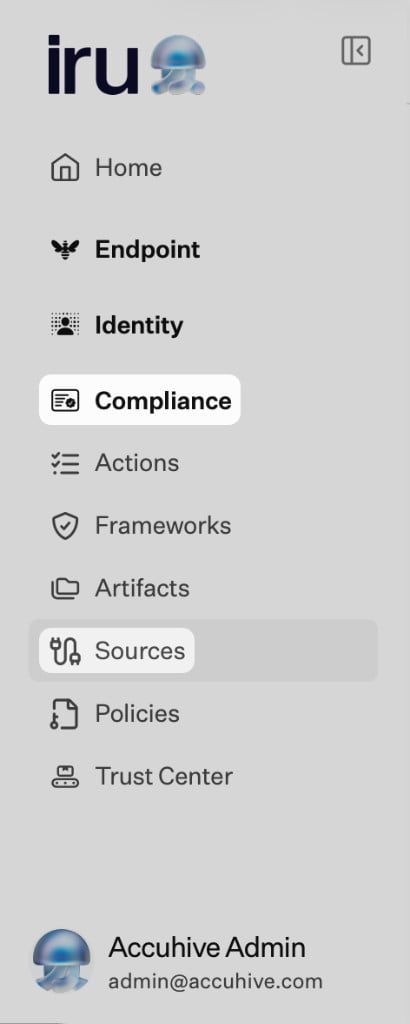 Find **Klaviyo** (use **Category** or **Search by name or description**). On that card, turn on the **toggle**. A browser tab or window may open for the connector wizard.
Paste the **private API key**.
Click **Submit Credentials**. When the connection succeeds, the wizard shows **Connection Configured**.
Close the **Iru is requesting access to external services** browser tab, then return to **Compliance** → **Sources** and confirm the **Klaviyo** card is **Active**.
### Troubleshooting
Check **pop-up blocker** settings for the Iru site and try again.
Confirm you created a **private** key, not a public one. The public key is a short company ID used for client-side calls and will not authenticate a server-to-server request.
The private key was created with **custom scopes** that exclude them. Klaviyo scopes are fixed at creation. Create a new key with the scopes you need.
Either the key lacks read access to them or list and segment monitoring is out of scope for this connection.
This is expected. Iru collects list and segment **metadata**, not the profiles within them.
### Related Articles
Browse and manage every Compliance source.
Frameworks, actions, and **Artifacts**.
How Endpoint, Compliance, and Identity fit together.
Upload, review, and organize evidence from sources and actions.
Find **Klaviyo** (use **Category** or **Search by name or description**). On that card, turn on the **toggle**. A browser tab or window may open for the connector wizard.
Paste the **private API key**.
Click **Submit Credentials**. When the connection succeeds, the wizard shows **Connection Configured**.
Close the **Iru is requesting access to external services** browser tab, then return to **Compliance** → **Sources** and confirm the **Klaviyo** card is **Active**.
### Troubleshooting
Check **pop-up blocker** settings for the Iru site and try again.
Confirm you created a **private** key, not a public one. The public key is a short company ID used for client-side calls and will not authenticate a server-to-server request.
The private key was created with **custom scopes** that exclude them. Klaviyo scopes are fixed at creation. Create a new key with the scopes you need.
Either the key lacks read access to them or list and segment monitoring is out of scope for this connection.
This is expected. Iru collects list and segment **metadata**, not the profiles within them.
### Related Articles
Browse and manage every Compliance source.
Frameworks, actions, and **Artifacts**.
How Endpoint, Compliance, and Identity fit together.
Upload, review, and organize evidence from sources and actions.