> ## Documentation Index
> Fetch the complete documentation index at: https://docs.iru.com/llms.txt
> Use this file to discover all available pages before exploring further.
# Heroku
> Connect Heroku to Iru Compliance with a Platform API token to collect app, pipeline, add-on, team-access, and dyno configuration evidence for audits.
### About Heroku
Iru reads **app** and **dyno** configuration, **pipelines**, **add-ons**, and **team** access metadata via the **Heroku Platform API** using a **Bearer** token (CLI authorization or account API key).
### How It Works
```http theme={null}
Authorization: Bearer YOUR_TOKEN
```
| Detail | Value |
| ------------------ | --------------------------- |
| **Category** | PaaS / developer tooling |
| **Authentication** | Platform API token (Bearer) |
Heroku tokens are **not** finely scoped; they inherit everything the generating account can access. Prefer a **dedicated** account with minimal team membership.
Official references: [Authentication](https://devcenter.heroku.com/articles/authentication), [Platform API](https://devcenter.heroku.com/articles/platform-api-reference), [CLI](https://devcenter.heroku.com/articles/heroku-cli).
### Prerequisites
* Access to the **Heroku CLI** **or** dashboard **API Key** section.
* Awareness of **SSO**: tokens may align to shorter session windows. See Heroku docs for **`--expires-in`**.
### Connect Heroku to Iru
Complete this tab before you connect the source in Compliance.
Most teams use the **Heroku CLI** so the token is scoped as an **authorization**. If you cannot use the CLI, use the dashboard **API Key** path in the steps below instead.
On a trusted workstation, run **`heroku login`** (or **`heroku login -i`** for CI-style flows) and complete authentication with an account that can create authorizations.
Run **`heroku authorizations:create --description "Iru Compliance"`**. Default expiry is often **one year**; SSO orgs may see shorter lifetimes. Add **`--expires-in`** when your policy requires a shorter TTL.
Copy the **Token** string from the command output and store it in a vault until you paste it into Iru.
In the [Heroku Dashboard](https://dashboard.heroku.com), select your **avatar** → **Account settings** (or **Account**).
Open the **API Key** section. Use **Reveal** to copy the existing account-wide key, or **Regenerate** to issue a new one. **Regenerate** invalidates the prior key everywhere, so update every integration that used the old key, not only Iru.
Continue on the [**Iru Compliance**](#iru-compliance) tab.
Finish the [**Heroku**](#heroku) tab first.
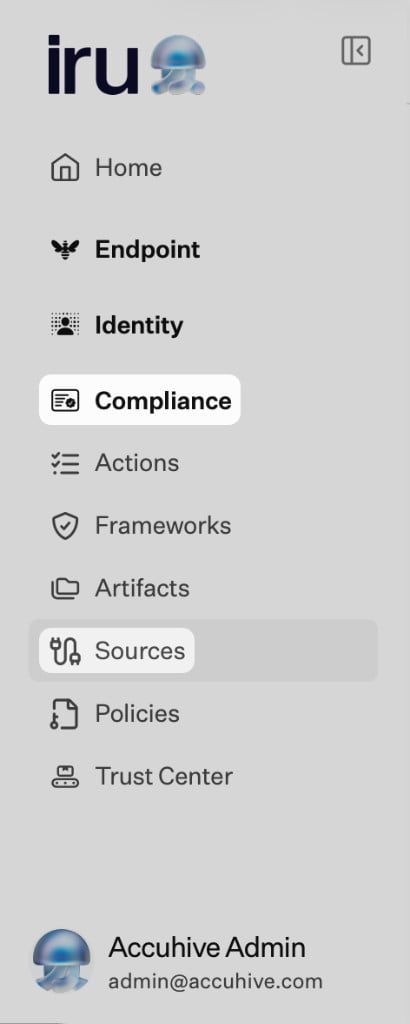
In Iru Compliance, on the left navigation bar, expand **Compliance** and select **Sources**.
 Find **Heroku** (use **Category** or **Search by name or description**). On that card, turn on the **toggle**. A browser tab or window may open for the connector wizard.
Paste the token into the **Bearer** field.
Click **Submit Bearer Token**. When the connection succeeds, the wizard shows **Connection Configured**.
Close the **Iru is requesting access to external services** browser tab, then return to **Compliance** → **Sources** and confirm the **Heroku** card is **Active**.
### Troubleshooting
Check **pop-up blocker** settings for the Iru site and try again.
Full token; SSO session may require a fresh authorization.
Dashboard regeneration invalidates old tokens. Update Iru.
Token’s account must belong to the right **teams**.
### Considerations
Iru is **read-only**; no deploys, scales, or restarts.
### Related Articles
Browse and manage every Compliance source.
Frameworks, actions, and **Artifacts**.
How Endpoint, Compliance, and Identity fit together.
Upload, review, and organize evidence from sources and actions.
Find **Heroku** (use **Category** or **Search by name or description**). On that card, turn on the **toggle**. A browser tab or window may open for the connector wizard.
Paste the token into the **Bearer** field.
Click **Submit Bearer Token**. When the connection succeeds, the wizard shows **Connection Configured**.
Close the **Iru is requesting access to external services** browser tab, then return to **Compliance** → **Sources** and confirm the **Heroku** card is **Active**.
### Troubleshooting
Check **pop-up blocker** settings for the Iru site and try again.
Full token; SSO session may require a fresh authorization.
Dashboard regeneration invalidates old tokens. Update Iru.
Token’s account must belong to the right **teams**.
### Considerations
Iru is **read-only**; no deploys, scales, or restarts.
### Related Articles
Browse and manage every Compliance source.
Frameworks, actions, and **Artifacts**.
How Endpoint, Compliance, and Identity fit together.
Upload, review, and organize evidence from sources and actions.