> ## Documentation Index
> Fetch the complete documentation index at: https://docs.iru.com/llms.txt
> Use this file to discover all available pages before exploring further.
# Datadog
> Connect Datadog to Iru Compliance with API and application key credentials to collect monitor configuration, user inventory, and security-posture evidence.
### About Datadog
The **Datadog** connector reads account configuration and security-oriented data: monitors, users and teams, integrations posture, and related settings. You can attach this evidence to controls in Iru Compliance. Transport uses Datadog’s HTTP APIs with your **API key** (`DD-API-KEY`). Some read paths may also require an **application key** (`DD-APPLICATION-KEY`); the in-product wizard reflects what Iru needs for your tenant.
### How It Works
Datadog separates keys by purpose:
* **API keys** authenticate data plane traffic and many configuration reads via `DD-API-KEY`.
* **Application keys** pair with API keys for certain configuration APIs via `DD-APPLICATION-KEY`.
The connector focuses on **read** operations for compliance evidence. **Iru does not ship custom metrics or logs** into Datadog as part of this source.
| Detail | Value |
| ------------------ | ------------------------------------------------------------------------------------------------------ |
| **Category** | Security / observability |
| **Authentication** | API key (and application key when required) |
| **Region** | Datadog is **region-specific** (US, EU, and so on). Use the org and endpoints that match your account. |
Documentation: [API and application keys](https://docs.datadoghq.com/account_management/api-app-keys/), [Authentication](https://docs.datadoghq.com/api/latest/authentication/), [Rate limits](https://docs.datadoghq.com/api/latest/rate-limits/).
### Prerequisites
* **Org Admin** (or equivalent) access to create keys in Datadog.
* Awareness of your **Datadog site** (`datadoghq.com`, `datadoghq.eu`, FedRAMP variants, and so on).
### Connect Datadog to Iru
Complete this tab before you connect the source in Compliance.
Open your org’s Datadog URL (for example **`app.datadoghq.com`**, **`app.datadoghq.eu`**, or your **FedRAMP** / **Gov** host). Sign in with a role that can manage **Organization Settings**.
From the left nav or avatar menu, choose **Organization Settings** (sometimes under **Access** or **Administration**, depending on layout).
Select **API Keys**. You should see existing keys and a control to create a new one (path similar to **Organization Settings** → **API Keys**).
Select **New Key**. Enter a name such as **Iru Compliance** and create the key.
Datadog caps **API keys per organization** (commonly **50**). Delete unused keys if you are near the limit.
**Copy** the key value immediately and store it like a password until you paste it in **Iru Compliance**. Datadog may show the full value only at creation.
Continue on the [**Iru Compliance**](#iru-compliance) tab.
Finish the [**Datadog**](#datadog) tab first.
In Iru Compliance, on the left navigation bar, expand **Compliance** and select **Sources**.
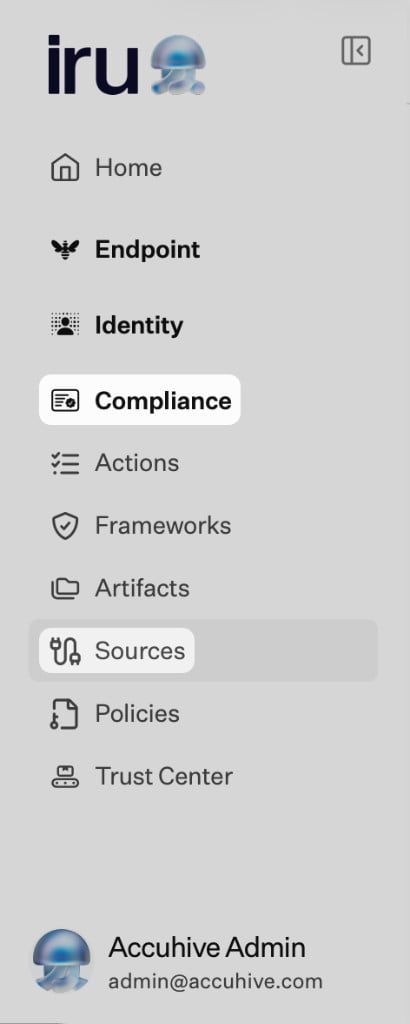 Find **Datadog** (set **Category** to **Monitoring** or use **Search by name or description**). On that card, turn on the **toggle**. A browser tab or window may open for the connector wizard.
When the wizard asks for it, paste your Datadog **API key**.
If the wizard asks for an **application key**, create one in Datadog under **Organization Settings** → **Application Keys**, then paste it (and the API key if asked again) in the wizard.
Click **Submit API Key**. When the connection succeeds, the wizard shows **Connection Configured**.
Close the **Iru is requesting access to external services** browser tab, then return to **Compliance** → **Sources** and confirm the **Datadog** card is **Active**.
### Troubleshooting
Check **pop-up blocker** settings for the Iru site and try again.
Validate the API key string. Confirm you are using keys from the **same org and site** your tenant expects.
Some endpoints require **both** API and application keys. Supply both if prompted.
Back off and retry; large accounts may need wider sync windows. Check Datadog’s rate-limit headers on failing calls.
Align endpoints with your Datadog site (US vs EU vs other).
### Considerations
API keys **do not auto-expire**. Rotate on your own schedule and update Iru when you rotate.
Rate limits vary by endpoint; initial backfills can take time on busy organizations.
Evidence reflects APIs your keys can access. Least-privilege keys may intentionally return narrower data.
### Related Articles
Browse and manage every Compliance source.
Frameworks, actions, and **Artifacts**.
How Endpoint, Compliance, and Identity fit together.
Upload, review, and organize evidence from sources and actions.
Find **Datadog** (set **Category** to **Monitoring** or use **Search by name or description**). On that card, turn on the **toggle**. A browser tab or window may open for the connector wizard.
When the wizard asks for it, paste your Datadog **API key**.
If the wizard asks for an **application key**, create one in Datadog under **Organization Settings** → **Application Keys**, then paste it (and the API key if asked again) in the wizard.
Click **Submit API Key**. When the connection succeeds, the wizard shows **Connection Configured**.
Close the **Iru is requesting access to external services** browser tab, then return to **Compliance** → **Sources** and confirm the **Datadog** card is **Active**.
### Troubleshooting
Check **pop-up blocker** settings for the Iru site and try again.
Validate the API key string. Confirm you are using keys from the **same org and site** your tenant expects.
Some endpoints require **both** API and application keys. Supply both if prompted.
Back off and retry; large accounts may need wider sync windows. Check Datadog’s rate-limit headers on failing calls.
Align endpoints with your Datadog site (US vs EU vs other).
### Considerations
API keys **do not auto-expire**. Rotate on your own schedule and update Iru when you rotate.
Rate limits vary by endpoint; initial backfills can take time on busy organizations.
Evidence reflects APIs your keys can access. Least-privilege keys may intentionally return narrower data.
### Related Articles
Browse and manage every Compliance source.
Frameworks, actions, and **Artifacts**.
How Endpoint, Compliance, and Identity fit together.
Upload, review, and organize evidence from sources and actions.