> ## Documentation Index
> Fetch the complete documentation index at: https://docs.iru.com/llms.txt
> Use this file to discover all available pages before exploring further.
# AWS CodeCommit
> Connect AWS CodeCommit to Iru Compliance with a cross-account IAM role to collect repository inventory, branch protection, and pull request history.
### About AWS CodeCommit
**CodeCommit** is **Regional**, so Iru walks enabled Regions. Attach **`AWSCodeCommitReadOnly`**, which includes **`codecommit:GitPull`**, **`BatchGet*`**, **`Describe*`**, **`Get*`**, **`List*`**, and pull-request approval evaluation. If repositories use a **customer-managed KMS** key, add **`kms:Decrypt`** for that key’s ARN.
### How It Works
Iru runs in its own AWS account. To read **CodeCommit** repositories and related metadata in your account, you create an **IAM role** that Iru can **assume** via **`sts:AssumeRole`**, gated by the wizard **External ID**, with read-only **`codecommit:`** permissions (for example **`AWSCodeCommitReadOnly`** or the inline JSON on the [**AWS**](#aws) tab). You then paste the role’s **ARN** back into Iru.
| Detail | Value |
| ------------------ | ---------------------- |
| **Category** | Developer tools |
| **Authentication** | Cross-account IAM role |
### Prerequisites
* IAM rights to **create roles**.
* At least one CodeCommit repository where you expect evidence.
### Connect AWS CodeCommit to Iru
Start here: open the source wizard and copy the **trust policy** (and note the **external ID**). When you are ready to create the role in AWS, switch to the [**AWS**](#aws) tab and follow [**Create the IAM role in AWS**](#create-the-iam-role-in-aws). After you have the **Role ARN**, return to the [**Iru Compliance**](#iru-compliance) tab and complete [**Submit the role ARN in Iru**](#submit-the-role-arn-in-iru) below.
#### Get the trust policy from Iru
In Iru Compliance, on the left navigation bar, expand **Compliance** and select **Sources**.
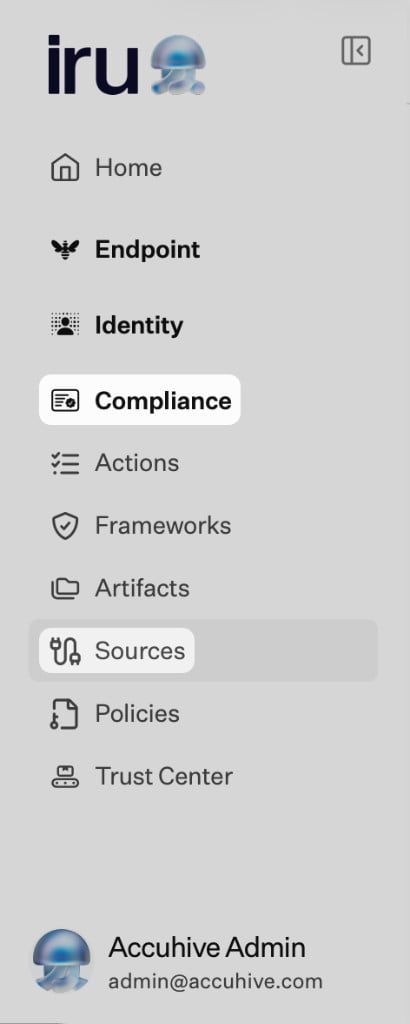 Find **AWS CodeCommit** (use **Category** or **Search by name or description**). On that card, turn on the **toggle**. Leave the **Iru is requesting access to external services** wizard tab open.
The wizard shows the **trust policy** JSON your IAM role must use (**Principal** and **sts:ExternalId**). Below is an **example** of the structure; **copy the live JSON from your wizard** so the account, principal ARN, and external ID match exactly.
```json copy=false lines theme={null}
{
"Version": "2012-10-17",
"Statement": [
{
"Effect": "Allow",
"Principal": {
"AWS": "arn:aws:iam::753695775620:role/IruConnect"
},
"Condition": {
"StringEquals": {
"sts:ExternalId": "YOUR_EXTERNAL_ID"
}
},
"Action": "sts:AssumeRole"
}
]
}
```
Keep the Iru wizard tab open for reference, then switch to the [**AWS**](#aws) tab and follow [**Create the IAM role in AWS**](#create-the-iam-role-in-aws).
#### Submit the role ARN in Iru
Finish the [**AWS**](#aws) tab first (through [**Create the IAM role in AWS**](#create-the-iam-role-in-aws)) so you have the **Role ARN** from the new role.
Return to the Iru wizard tab. Paste the **Role ARN** where the connector prompts for it.
Click **Submit Role**. When the connection succeeds, the wizard shows **Connection Configured**.
Close the **Iru is requesting access to external services** browser tab, then return to **Compliance** → **Sources** and confirm the **AWS CodeCommit** card is **Active**.
Complete [**Get the trust policy from Iru**](#get-the-trust-policy-from-iru) on the [**Iru Compliance**](#iru-compliance) tab before you create this role. Use the **external ID** and trust policy from the live wizard when you configure **Trusted entity**.
#### Create the IAM role in AWS
Open **IAM** → **Roles** → **Create role**.
Choose **AWS account** → **Another AWS account**. Enter **`753695775620`** (or the ID Iru shows). Enable **Require external ID** and paste the external ID from Iru.
Attach **`AWSCodeCommitReadOnly`**.
If repositories use a customer-managed KMS key, add an **inline policy** (replace **REGION**, **ACCOUNT**, **CMK-ID**):
```json lines theme={null}
{
"Version": "2012-10-17",
"Statement": [
{
"Effect": "Allow",
"Action": ["kms:Decrypt"],
"Resource": "arn:aws:kms:REGION:ACCOUNT:key/CMK-ID"
}
]
}
```
Name the role, create it, and copy the **Role ARN**. Switch back to the [**Iru Compliance**](#iru-compliance) tab and complete [**Submit the role ARN in Iru**](#submit-the-role-arn-in-iru).
Confirm **Trust relationships** matches the wizard JSON.
Continue on the [**Iru Compliance**](#iru-compliance) tab to paste the **Role ARN** and finish the wizard ([**Submit the role ARN in Iru**](#submit-the-role-arn-in-iru)).
### Troubleshooting
Check **pop-up blocker** settings for the Iru site and try again.
Add **`kms:Decrypt`** for that repository’s CMK.
Confirm the **Region** you use in AWS matches where repos exist.
External ID mismatch.
### Considerations
CodeCommit was announced for **end of new customer access** in **July 2024** - plan migrations and retire this source when repos move.
### Related Articles
Browse and manage every Compliance source.
Frameworks, actions, and **Artifacts**.
How Endpoint, Compliance, and Identity fit together.
Upload, review, and organize evidence from sources and actions.
Find **AWS CodeCommit** (use **Category** or **Search by name or description**). On that card, turn on the **toggle**. Leave the **Iru is requesting access to external services** wizard tab open.
The wizard shows the **trust policy** JSON your IAM role must use (**Principal** and **sts:ExternalId**). Below is an **example** of the structure; **copy the live JSON from your wizard** so the account, principal ARN, and external ID match exactly.
```json copy=false lines theme={null}
{
"Version": "2012-10-17",
"Statement": [
{
"Effect": "Allow",
"Principal": {
"AWS": "arn:aws:iam::753695775620:role/IruConnect"
},
"Condition": {
"StringEquals": {
"sts:ExternalId": "YOUR_EXTERNAL_ID"
}
},
"Action": "sts:AssumeRole"
}
]
}
```
Keep the Iru wizard tab open for reference, then switch to the [**AWS**](#aws) tab and follow [**Create the IAM role in AWS**](#create-the-iam-role-in-aws).
#### Submit the role ARN in Iru
Finish the [**AWS**](#aws) tab first (through [**Create the IAM role in AWS**](#create-the-iam-role-in-aws)) so you have the **Role ARN** from the new role.
Return to the Iru wizard tab. Paste the **Role ARN** where the connector prompts for it.
Click **Submit Role**. When the connection succeeds, the wizard shows **Connection Configured**.
Close the **Iru is requesting access to external services** browser tab, then return to **Compliance** → **Sources** and confirm the **AWS CodeCommit** card is **Active**.
Complete [**Get the trust policy from Iru**](#get-the-trust-policy-from-iru) on the [**Iru Compliance**](#iru-compliance) tab before you create this role. Use the **external ID** and trust policy from the live wizard when you configure **Trusted entity**.
#### Create the IAM role in AWS
Open **IAM** → **Roles** → **Create role**.
Choose **AWS account** → **Another AWS account**. Enter **`753695775620`** (or the ID Iru shows). Enable **Require external ID** and paste the external ID from Iru.
Attach **`AWSCodeCommitReadOnly`**.
If repositories use a customer-managed KMS key, add an **inline policy** (replace **REGION**, **ACCOUNT**, **CMK-ID**):
```json lines theme={null}
{
"Version": "2012-10-17",
"Statement": [
{
"Effect": "Allow",
"Action": ["kms:Decrypt"],
"Resource": "arn:aws:kms:REGION:ACCOUNT:key/CMK-ID"
}
]
}
```
Name the role, create it, and copy the **Role ARN**. Switch back to the [**Iru Compliance**](#iru-compliance) tab and complete [**Submit the role ARN in Iru**](#submit-the-role-arn-in-iru).
Confirm **Trust relationships** matches the wizard JSON.
Continue on the [**Iru Compliance**](#iru-compliance) tab to paste the **Role ARN** and finish the wizard ([**Submit the role ARN in Iru**](#submit-the-role-arn-in-iru)).
### Troubleshooting
Check **pop-up blocker** settings for the Iru site and try again.
Add **`kms:Decrypt`** for that repository’s CMK.
Confirm the **Region** you use in AWS matches where repos exist.
External ID mismatch.
### Considerations
CodeCommit was announced for **end of new customer access** in **July 2024** - plan migrations and retire this source when repos move.
### Related Articles
Browse and manage every Compliance source.
Frameworks, actions, and **Artifacts**.
How Endpoint, Compliance, and Identity fit together.
Upload, review, and organize evidence from sources and actions.